
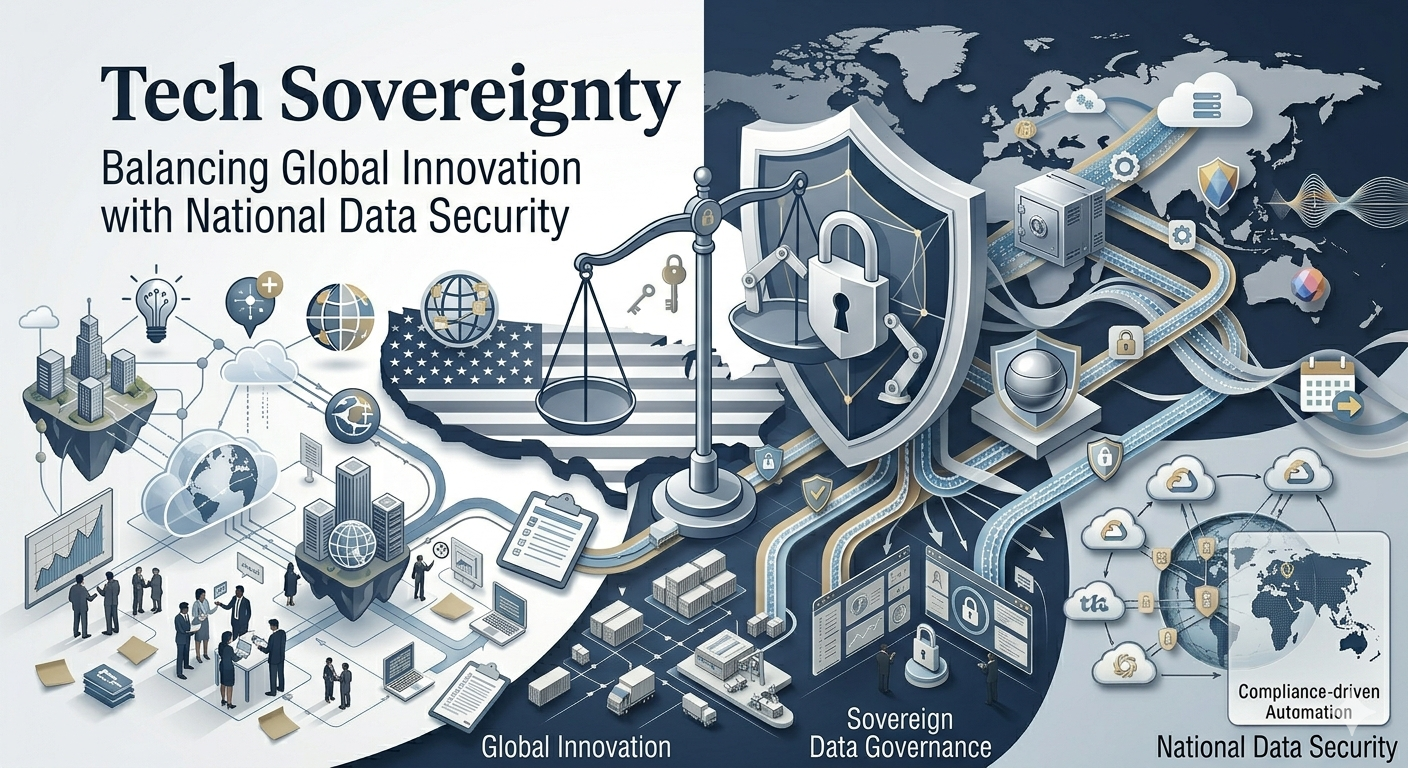
Introduction In 2026, the “borderless” dream of the early internet has met the reality of the physical world. We have entered the era of Tech Sovereignty. As nations realize that digital infrastructure is just as critical as energy or water, the push to localize data, code, and hardware has become the defining geopolitical trend of the year. For global businesses, this means the end of a single, unified tech stack and the beginning of a complex, fragmented digital landscape.
The Three Pillars of Tech Sovereignty
- Sovereign AI Compute: Nations are no longer content with relying on a handful of foreign cloud providers. By the end of 2026, global investment in “Sovereign AI” is expected to exceed $100 billion. Countries are building their own high-performance computing clusters to ensure their national AI models aren’t subject to the export controls or political whims of other powers.
- Data Residency vs. Data Sovereignty: While residency is about where data is stored, sovereignty is about which laws apply to it. In 2026, “Sovereign Clouds” have become the gold standard for enterprise. These are cloud environments operated by local companies within local jurisdictions, ensuring that sensitive data—like health records or financial transactions—never leaves the legal protection of the home country.
- Semiconductor Independence: The global chip shortage of the early 2020s taught a hard lesson. Now, massive domestic “fabs” (semiconductor fabrication plants) are coming online in Europe, India, and North America, reducing the reliance on a few concentrated geographic points in Asia.
The Impact on Global Enterprise For a CTO, Tech Sovereignty introduces significant friction. You can no longer run a “global” instance of your software. Instead, you must adopt a Multi-Local Strategy:
- Bifurcated Infrastructure: Companies are essentially building two (or more) versions of their tech stack—one that complies with EU regulations (GDPR, EU AI Act) and another for the US or Asian markets.
- The Trust Premium: In 2026, security certifications like ISO/IEC 42001 have become the “credit rating” of the tech world. If you cannot prove the “sovereignty” of your data pipeline, you simply cannot win government or high-value institutional contracts.







Leave a Reply