
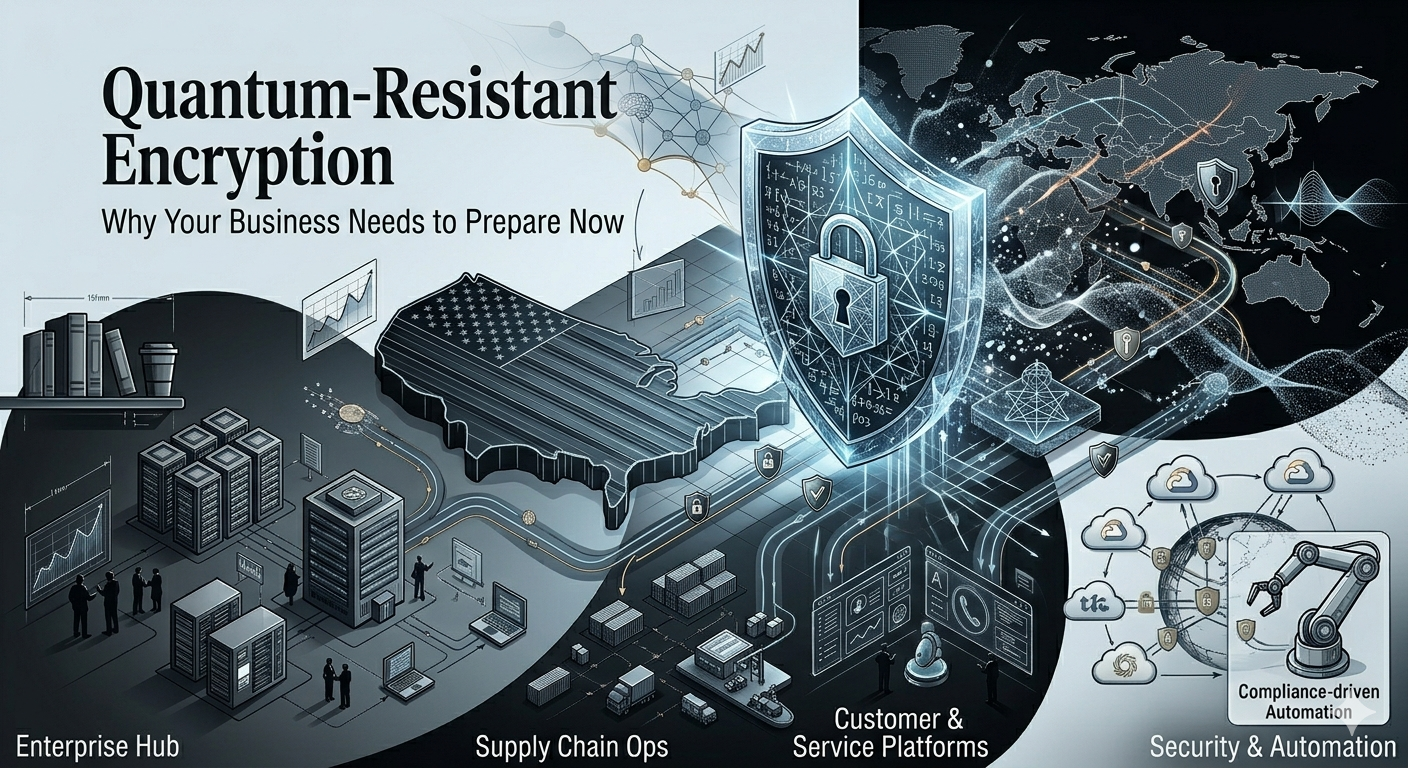

Quantum-Resistant Encryption is becoming an important cybersecurity priority for businesses preparing for the next generation of computing. While quantum computers capable of breaking widely used encryption methods such as RSA and ECC are still under development, attackers may already be collecting encrypted information today. This strategy is often called “Harvest Now, Decrypt Later,” where criminals steal and store encrypted data with the hope of decrypting it in the future. For organizations handling financial records, customer information, intellectual property, or confidential communications, can become an essential part of long-term security planning.
Table of Contents
- Understanding Quantum-Resistant Encryption
- Why Quantum-Resistant Encryption Matters Now
- NIST Standards for Quantum-Resistant Encryption
- Cryptographic Inventory for Quantum-Resistant Encryption
- Hybrid Deployment and Quantum-Resistant Encryption
- Vendor Planning for Quantum-Resistant Encryption
- Quantum Agility and Future Security
- Cost of Delaying Quantum-Resistant Encryption
- Conclusion
Understanding Quantum-Resistant Encryption
Quantum-Resistant Encryption refers to cryptographic technologies designed to protect information against attacks from powerful quantum computers. Traditional public-key algorithms such as RSA and elliptic-curve cryptography, commonly known as ECC, depend on mathematical problems that could potentially be solved much faster by sufficiently capable quantum computers.
Quantum computing does not automatically break every form of encryption. However, certain quantum algorithms could create serious risks for widely used public-key cryptography. This is why businesses are beginning to prepare for a transition toward before large-scale quantum computers become practical.
The goal is not simply to replace one algorithm with another. A successful transition requires organizations to understand where cryptography is used, which systems depend on it, and how new security standards can be introduced without disrupting business operations.
Why Quantum-Resistant Encryption Matters Now
The biggest concern is the “Harvest Now, Decrypt Later” threat. An attacker does not necessarily need to decrypt stolen information today. Instead, encrypted data can be collected and stored until technology becomes capable of breaking the protection.
This creates a problem for information that must remain confidential for many years. Medical records, financial information, government-related documents, intellectual property, authentication credentials, and sensitive business communications may have long-term value.
addresses this long-term security challenge by preparing cryptographic systems for a future in which quantum attacks become more realistic.
Quantum-Resistant Encryption and Long-Lived Data
Businesses should consider how long their sensitive information needs to remain private. Data with a confidentiality requirement of five, ten, or more years could face a greater future risk than information that becomes irrelevant quickly.
For example, if an organization needs confidential information to remain protected until 2035, it cannot only consider the security threats of 2026. Long-term security planning makes relevant today because encryption decisions made now can affect data protection years into the future.
NIST Standards for Quantum-Resistant Encryption
The National Institute of Standards and Technology has been developing and standardizing post-quantum cryptographic algorithms to help organizations prepare for quantum-era security requirements.
Two important standards are ML-KEM and ML-DSA. ML-KEM is designed for key establishment, while ML-DSA is designed for digital signatures.
ML-KEM and Quantum-Resistant Encryption
ML-KEM, formerly associated with CRYSTALS-Kyber, is designed to help establish shared cryptographic keys between communicating parties. Key-establishment mechanisms are important for technologies such as secure communications, websites, applications, and cloud services.
Organizations evaluating should understand where key-establishment technologies are currently used throughout their infrastructure.
ML-DSA and Quantum-Resistant Encryption
ML-DSA, formerly associated with CRYSTALS-Dilithium, is designed for digital signatures. Digital signatures help verify authenticity and integrity, making them important for software updates, certificates, identity systems, and other security applications.
As businesses migrate toward , digital-signature infrastructure will also need attention rather than focusing only on encrypted communications.
Cryptographic Inventory for Quantum-Resistant Encryption
A successful strategy starts with visibility. Organizations cannot protect cryptographic systems they do not know they are using.
A cryptographic inventory should identify encryption and authentication technologies across applications, servers, databases, networks, cloud environments, VPNs, APIs, certificates, and employee devices. Legacy systems deserve special attention because older technologies can be difficult to upgrade.
Finding Legacy Systems with Quantum-Resistant Encryption
Legacy applications may contain hard-coded cryptographic algorithms or outdated libraries that are difficult to replace. Businesses should document these dependencies before beginning large-scale migration.
This process can reveal where can be introduced immediately and where additional modernization may be required.
Hybrid Deployment and Quantum-Resistant Encryption
Replacing every existing cryptographic system at once is rarely practical. Businesses operate complex environments containing modern applications, legacy infrastructure, third-party services, and systems that cannot easily be upgraded.
Hybrid approaches can therefore play an important role in the transition toward. A hybrid design may combine traditional cryptographic mechanisms with post-quantum mechanisms to support compatibility while organizations gradually modernize their infrastructure.
Benefits of a Quantum-Resistant Encryption Hybrid Strategy
A carefully designed hybrid strategy can allow organizations to test post-quantum technologies without immediately abandoning existing systems. It can also provide an opportunity to identify compatibility issues, performance requirements, certificate challenges, and operational problems before wider deployment.
The exact implementation depends on the technology involved, so businesses should follow current standards and vendor guidance rather than assuming that every hybrid configuration provides the same level of protection.
Vendor Planning for Quantum-Resistant Encryption
Businesses increasingly depend on cloud platforms, SaaS applications, networking equipment, cybersecurity products, and managed services. This means an organization’s readiness can depend partly on its technology vendors.
Companies should ask vendors whether their products support or plan to support post-quantum cryptography. They should also ask how cryptographic algorithms can be upgraded and whether their systems provide a clear migration path.
Quantum-Resistant Encryption Questions for Vendors
Organizations can ask vendors about their post-quantum roadmap, supported standards, certificate compatibility, software-update processes, cryptographic dependencies, and expected migration timelines.
These questions can help businesses identify technology providers that are actively preparing their products for Quantum-Resistant Encryption requirements.
Quantum Agility and Future Security
Quantum readiness is not only about selecting a new cryptographic algorithm. Businesses also need the ability to change algorithms efficiently as standards and threats evolve.
This concept is known as cryptographic agility or “crypto agility.” It means systems are designed so cryptographic algorithms can be updated without rebuilding an entire application or infrastructure environment.
Building Quantum-Resistant Encryption Agility
Organizations can improve agility by avoiding unnecessary hard-coding of cryptographic algorithms, maintaining updated cryptographic libraries, documenting dependencies, and designing systems that can accommodate future standards.
This approach makes Quantum-Resistant Encryption migration more manageable because organizations can replace cryptographic components without creating major disruptions throughout the technology stack.
Cost of Delaying Quantum-Resistant Encryption
Waiting until quantum computers become capable of breaking existing cryptography could create unnecessary pressure. Large organizations may have thousands of applications, certificates, devices, databases, and third-party integrations that depend on cryptographic technology.
Migration can take considerable time because security teams need to discover dependencies, test replacements, update systems, coordinate with vendors, and validate compatibility.
For that reason, Quantum-Resistant Encryption should be considered a long-term technology migration rather than a last-minute cybersecurity project.
Quantum-Resistant Encryption and Business Continuity
Cybersecurity modernization should not interrupt essential business operations. A phased approach can allow organizations to evaluate risks, test new technologies, upgrade high-priority systems, and gradually expand deployment.
The following framework provides a simple way to think about the transition:
| Stage | Main Goal | Quantum-Resistant Encryption Focus |
|---|---|---|
| Discovery | Identify cryptographic assets | Build a cryptographic inventory |
| Assessment | Find high-risk systems | Prioritize long-lived sensitive data |
| Testing | Evaluate new technologies | Test post-quantum algorithms |
| Migration | Upgrade suitable systems | Deploy Quantum-Resistant Encryption |
| Agility | Prepare for future changes | Make algorithms easier to replace |
A Practical Quantum-Resistant Encryption Roadmap
Businesses can begin with an inventory of cryptographic assets and identify information that requires long-term confidentiality. The next step is to evaluate which applications and infrastructure components depend on vulnerable public-key cryptography.
After that, security teams can test post-quantum algorithms in controlled environments. Organizations should work with technology providers to understand product roadmaps and determine which systems can support new standards.
Once testing is complete, businesses can create a phased migration plan. High-value data and systems with long confidentiality requirements may receive priority, while less critical infrastructure can be upgraded according to business needs.
Throughout the process, Quantum-Resistant Encryption should be treated as part of broader security architecture rather than as a single software installation.
Conclusion
Quantum-Resistant Encryption is becoming an important part of long-term cybersecurity planning as businesses prepare for advances in quantum computing. The immediate challenge is not necessarily that quantum computers can already break today’s encryption, but that sensitive encrypted information may be collected now and targeted in the future.
Organizations can prepare by creating a cryptographic inventory, understanding NIST post-quantum standards, testing hybrid approaches, communicating with vendors, and developing cryptographic agility.
The transition to Quantum-Resistant Encryption will take time, especially for large enterprises with complex technology environments. Starting with visibility and structured planning can help businesses understand their exposure and prepare their infrastructure for the evolving cryptographic landscape.