
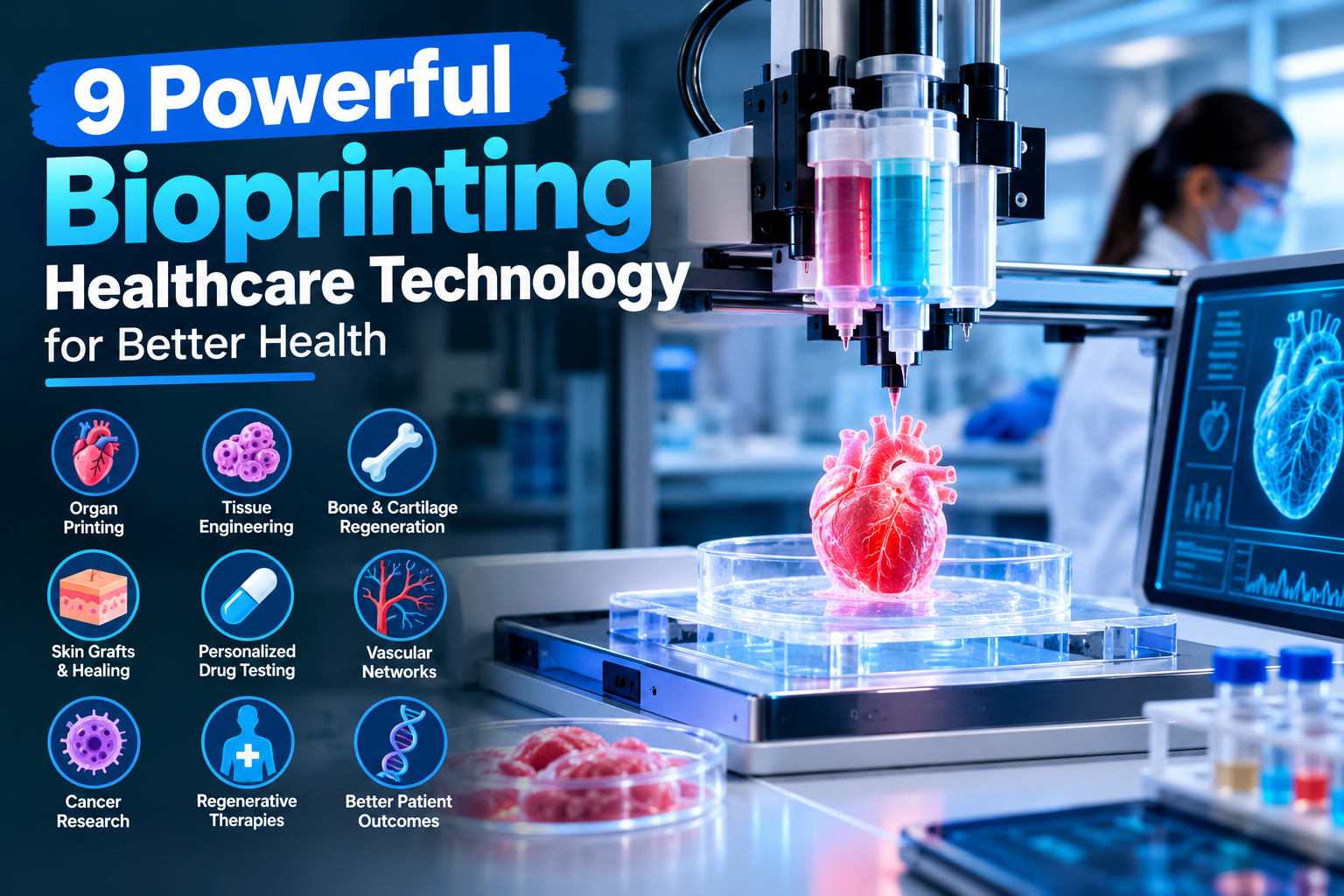

Bioprinting Healthcare Technology is becoming an important part of modern healthcare innovation, connecting advanced 3D printing, biotechnology, artificial intelligence, and personalized medicine. Healthcare is increasingly moving beyond traditional hospitals and clinics toward technologies that can monitor, model, repair, and potentially regenerate human tissue. From patient-specific tissue models to smart biological systems, helping researchers explore new approaches to diagnosis, drug development, and regenerative medicine.
The idea of having a “laboratory in your pocket” is becoming increasingly realistic as healthcare technology becomes more connected. Digital health platforms, wearable sensors, AI systems, and biotechnology can work together to provide more personalized information. At the same time, advances in bioprinting are allowing researchers to create increasingly complex biological structures for research and potential therapeutic applications.
Table of Contents
- Bioprinting Healthcare Technology and 3D Tissue Printing
- Bioprinting Healthcare Technology for Organ Patching
- Bioprinting Healthcare Technology and Drug Discovery
- The Bio-Ink Revolution in Bioprinting Healthcare Technology
- Bioprinting Healthcare Technology and Smart Implants
- In-Vivo Engineering and Bioprinting Healthcare Technology
- AI and Bioprinting Healthcare Technology
- Personalized Medicine Through Bioprinting Healthcare Technology
- The Future of Bioprinting Healthcare Technology
Bioprinting Healthcare Technology and 3D Tissue Printing
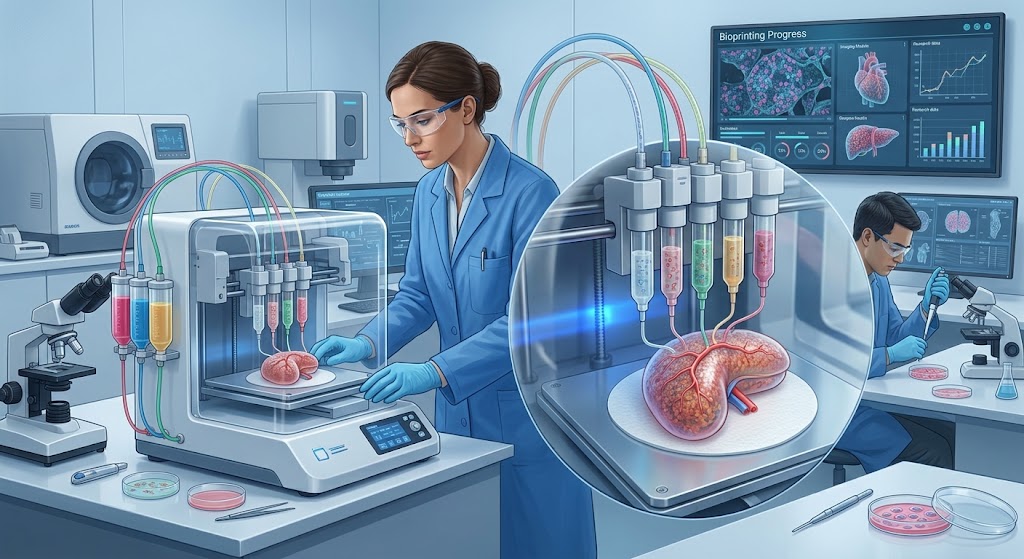
One of the most exciting areas of 3D bioprinting. Unlike conventional 3D printing, which uses materials such as plastic or metal, bioprinting can use biomaterials and living cells to build biological structures layer by layer.
Researchers are investigating how printed structures can support tissue regeneration and provide realistic models for medical research. The technology is particularly interesting because biological tissues have complex shapes and cellular arrangements that are difficult to reproduce using traditional manufacturing techniques.
While fully functional replacement organs remain a major research challenge, progress in tissue engineering continues to expand the potential applications of Bioprinting Healthcare Technology.
Bioprinting Healthcare Technology for Organ Patching
One potential application is creating customized tissue patches. Researchers are studying printed structures that could eventually help repair damaged skin, cartilage, blood vessels, and other tissues.
The major advantage of patient-specific approaches is that biological materials can potentially be designed around an individual’s anatomy and cellular characteristics. However, immune response, vascularization, long-term function, and manufacturing consistency remain important challenges that scientists must solve before many applications become routine.
Bioprinting Healthcare Technology for Drug Discovery
Another promising application of pharmaceutical research. Traditional drug development can be expensive and time-consuming, and researchers need reliable models for understanding how potential medicines interact with human tissues.
Bioprinted tissue models and organ-on-a-chip systems are being investigated as tools that can reproduce selected characteristics of human organs. Liver, heart, lung, and other tissue models can help researchers study biological responses under controlled laboratory conditions.
Bioprinting Healthcare Technology and Human Tissue Models
Human tissue models created through advanced biofabrication can provide researchers with additional ways to study disease mechanisms and drug responses. These models do not automatically replace every existing research method, but they can complement conventional approaches and may help make certain experiments more biologically relevant.
The long-term goal of in drug discovery is to create increasingly realistic tissue environments that allow scientists to evaluate therapies before they reach clinical testing.
The Bio-Ink Revolution in Bioprinting Healthcare Technology
Bio-ink is another major component of . Bio-inks are materials designed to support the printing of biological structures, often incorporating cells, biomaterials, or substances that provide an appropriate environment for cellular growth.
Developing a suitable bio-ink is challenging because it needs to balance printability with biological compatibility. A material must be able to form a stable structure while also supporting the cells contained within it.
Advanced Bio-Ink and Bioprinting Healthcare Technology
Scientists are experimenting with different natural and synthetic materials to improve bio-ink performance. The objective is to create materials that can produce complex structures while maintaining conditions that support living cells.
These developments could expand future applications of in regenerative medicine, tissue engineering, and laboratory research.
Bioprinting Healthcare Technology and Smart Implants
The combination of biotechnology and digital electronics is creating new possibilities for smart medical devices. Tiny biosensors can potentially monitor biological signals and transmit information to external systems.
This area connects Bioprinting Healthcare Technology with personalized digital healthcare. Instead of relying only on occasional measurements, researchers are exploring technologies capable of collecting biological information continuously or at frequent intervals.
Smart implants and biosensors are being studied for applications involving glucose, oxygen, temperature, pressure, and other physiological measurements. The exact capabilities vary considerably depending on the device and clinical application.
In-Vivo Engineering and Bioprinting Healthcare Technology
In-vivo engineering focuses on designing biological interventions that work inside the body rather than relying entirely on external tissue construction. This concept represents another direction in which intersects with regenerative medicine and advanced biotechnology.
Gene-editing technologies, targeted delivery systems, biomaterials, and tissue engineering are being investigated separately and in combination for treating specific medical conditions.
Gene Editing and Bioprinting Healthcare Technology
CRISPR-based technologies have generated significant interest because they can be designed to modify specific genetic sequences. Researchers are studying different delivery methods and therapeutic applications, but safety, precision, immune responses, and long-term effects remain important considerations.
For this reason, the future of Bioprinting Healthcare Technology is not limited to printing tissues. It also involves understanding how biological materials, cells, genes, and digital technologies can work together safely.
AI and Bioprinting Healthcare Technology
Artificial intelligence is becoming increasingly useful across healthcare research, and it can also support Bioprinting Healthcare Technology. AI systems can analyze biological data, assist with image analysis, optimize designs, and help researchers identify patterns within large datasets.
In bioprinting, computational models can potentially help researchers design tissue structures and evaluate printing parameters. AI may also contribute to personalized treatment planning by processing information from medical imaging and biological measurements.
Personalized Models With Bioprinting Healthcare Technology
One of the most interesting possibilities is combining a patient’s biological information with computer-assisted design. In theory, this could allow researchers to develop tissue models that more closely represent individual patients.
This personalized approach could support medical research and treatment development while reducing reliance on generic biological models. However, significant scientific and regulatory work is still required before many of these concepts can become widespread clinical practices.
Personalized Medicine Through Bioprinting Healthcare Technology
Personalized medicine aims to make healthcare more specific to individual patients rather than treating every patient in exactly the same way. Bioprinting Healthcare Technology could contribute to this goal by enabling researchers to create customized tissue models and investigate patient-specific biological responses.
For example, a patient’s cells could potentially be used in laboratory models to study how particular treatments affect their tissue. Such approaches could eventually support more targeted therapeutic research.
The combination of genomics, AI, biosensors, medical imaging, and bioprinting creates a broader technology ecosystem in which biological information can be used to develop more individualized healthcare strategies.
The Future of Bioprinting Healthcare Technology
The future of Bioprinting Healthcare Technology is likely to involve gradual improvements rather than a single breakthrough. Researchers are working on vascularization, tissue maturation, bio-inks, printing precision, cell survival, scalability, and regulatory requirements.
The ability to print a complete, fully functional human organ remains far more difficult than producing simpler tissue structures or laboratory models. Complex organs contain multiple cell types, blood vessels, nerves, mechanical structures, and biochemical systems that must work together.
What Bioprinting Healthcare Technology Could Change
As the technology develops, Bioprinting Healthcare Technology could influence regenerative medicine, pharmaceutical research, medical education, personalized treatment research, and biomedical engineering.
The most important progress may come from combining bioprinting with other technologies rather than using bioprinting alone. AI, advanced imaging, biomaterials, gene-editing research, and biosensors could collectively create new approaches to understanding and repairing biological systems.
Conclusion
Bioprinting Healthcare Technology represents a rapidly developing intersection of medicine, biotechnology, engineering, and digital technology. From bio-inks and tissue models to smart implants and personalized research, these technologies are opening new possibilities for healthcare innovation.
Although many futuristic applications still require extensive research and clinical validation, the direction is clear: healthcare technology is becoming increasingly connected with biology. As researchers improve the ability to design, monitor, and engineer living systems, Bioprinting Healthcare Technology could become an important part of the next generation of medical innovation.