
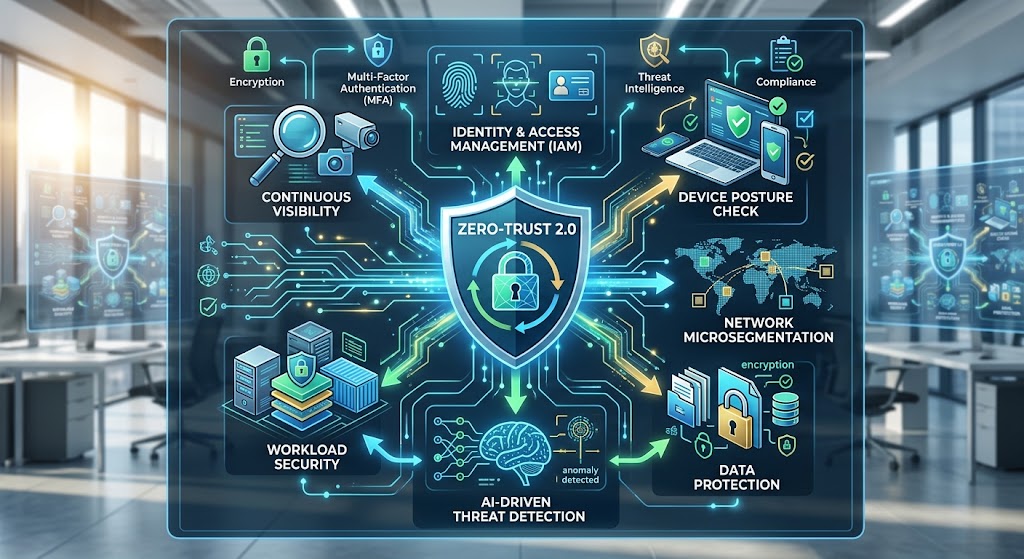

Zero-Trust 2.0 Security is changing how organizations protect modern workplaces as employees, cloud applications, connected devices, and AI systems become increasingly interconnected. The traditional security model often focused on protecting a network perimeter, but today’s digital environments make that approach much more difficult. Zero Trust follows a different principle: access should be continuously verified rather than automatically trusted.
In a hyperconnected workplace, a password or physical location alone may not provide enough context for every access decision. expands traditional Zero Trust concepts by combining identity controls, device security, behavioral signals, application-level segmentation, and automated threat detection.
Table of Contents
- Zero-Trust 2.0 Security and the New Trust Model
- Identity Protection With Zero-Trust 2.0 Security
- API Micro-Segmentation and Zero-Trust 2.0 Security
- Machine Identity in Zero-Trust 2.0 Security
- Device Posture and Zero-Trust 2.0 Security
- AI Threat Detection With Zero-Trust 2.0 Security
- Security-as-Code and Zero-Trust 2.0 Security
Zero-Trust 2.0 Security and the New Trust Model
The core idea behind Zero Trust is simple: users and devices should not receive automatic access simply because they are inside a particular network. Every access request should be evaluated according to identity, permissions, device status, application context, and other relevant signals.
Zero-Trust 2.0 Security builds on this approach by making security decisions more dynamic. Instead of treating authentication as a single event, organizations can continuously evaluate whether access remains appropriate throughout a session.
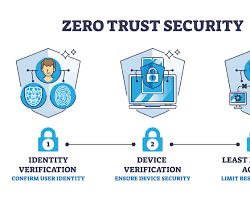
Continuous Verification With Zero-Trust 2.0 Security
Continuous verification can include multiple signals such as authentication strength, device health, unusual access behavior, location changes, and application activity.
If risk changes significantly during a session, security systems can require additional verification or restrict access. This creates a more adaptive approach.
Identity Protection With Zero-Trust 2.0 Security
Identity has become one of the most important components of enterprise security. Employees, contractors, applications, services, and automated systems can all require access to digital resources.
Zero-Trust 2.0 Security treats identity as an ongoing security signal rather than simply a username and password.
Behavioral Signals in Zero-Trust 2.0 Security
Behavioral analytics can examine patterns such as login behavior, access times, application usage, and unusual activity. In some environments, organizations may also evaluate behavioral biometrics, such as typing patterns or interaction characteristics.
These signals should generally complement stronger authentication methods rather than replace them. When unusual behavior appears, can trigger additional verification or limit access.
API Micro-Segmentation and Zero-Trust 2.0 Security
Modern applications communicate through APIs and distributed services rather than relying on a single traditional network. This makes application-level security an important part .
Micro-segmentation can restrict communication between services so that access to one application does not automatically provide access to unrelated systems.
API-Level Controls in Zero-Trust 2.0 Security
API-level authorization can evaluate whether a specific service or identity is allowed to perform a particular action. Cryptographic authentication, short-lived credentials, and granular permissions can further reduce unnecessary access.
This approach can limit lateral movement if an attacker compromises one application or account.
Machine Identity in Zero-Trust 2.0 Security
Humans are no longer the only identities operating within enterprise environments. Cloud services, APIs, IoT devices, automated workflows, and AI agents can all interact with digital systems.
Therefore needs to manage machine identities alongside human identities.
AI Agents and Zero-Trust 2.0 Security
AI agents can potentially access files, applications, APIs, and business systems on behalf of users or organizations. Giving these systems unrestricted permissions can create unnecessary risk.
A Zero Trust approach can instead provide narrowly defined permissions, monitor actions, and require appropriate authorization for sensitive operations.
This principle of least privilege is an important foundation of Zero-Trust 2.0 Security.
Device Posture and Zero-Trust 2.0 Security
A valid user account does not necessarily mean the device being used is secure. A laptop, smartphone, or workstation may have outdated software, missing security patches, or other security problems.
Can continuously evaluate device posture before and during access to sensitive resources.
Continuous Device Evaluation With Zero-Trust 2.0 Security
Device security checks can include operating-system versions, security updates, encryption status, endpoint protection, and other organizational requirements.
If a device no longer meets security policies, access can be reduced or blocked until the issue is resolved. This creates a dynamic relationship between identity, device health, and resource access.
AI Threat Detection With Zero-Trust 2.0 Security
Modern enterprises generate huge volumes of security data. Security teams may need to analyze authentication events, network activity, endpoint alerts, application logs, and other signals.
AI and machine-learning systems can assist with identifying unusual patterns within this information. In these capabilities can support automated risk analysis and security response.
Predictive Security in Zero-Trust 2.0 Security
AI-based systems can identify patterns associated with suspicious activity and help security teams prioritize potential threats. For example, unusual login behavior combined with abnormal application access could increase a session’s risk level.
However, automated security decisions require careful testing and monitoring. False positives and inaccurate classifications can disrupt legitimate users, making human oversight and appropriate controls important parts .
Security-as-Code and Zero-Trust 2.0 Security
Security is increasingly being integrated into software development and infrastructure deployment rather than being added after systems are built.
Security-as-Code allows security policies and controls to be represented within automated development and deployment workflows. This approach supports consistent enforcement across applications and infrastructure.
Secure-by-Design With Zero-Trust 2.0 Security
When Zero Trust policies are incorporated into deployment processes, developers can define authentication, authorization, secrets management, and access controls as part of the system architecture.
This can help make a continuous part of software development rather than a separate security layer added later.
The Future of Zero-Trust 2.0 Security
The future of will likely involve increasingly dynamic security decisions. Organizations are moving toward environments where human identities, machine identities, devices, applications, and AI agents all need carefully controlled access.
Continuous authentication, least-privilege permissions, micro-segmentation, device posture management, behavioral analytics, and automated threat detection can work together to create a more adaptive security architecture.
Building a Safer Hyperconnected Workplace With Zero-Trust 2.0 Security
A successful Zero Trust strategy is not simply about deploying one security product. It requires coordinated identity management, endpoint protection, application security, network controls, monitoring, governance, and user awareness.
As workplaces become more connected, can provide a framework for making access decisions based on current risk rather than assuming that a user or device should always be trusted.
Conclusion
Zero-Trust 2.0 Security represents an evolution of traditional Zero Trust principles for a workplace where cloud services, APIs, mobile devices, IoT systems, and AI agents are increasingly interconnected.
By continuously evaluating identity, device posture, application behavior, machine identities, and security signals, organizations can build more adaptive access controls. The goal is not to eliminate every cyber threat, but to reduce unnecessary trust and limit the potential impact of compromised accounts, devices, or applications.
As digital environments continue to expand, will remain closely connected to identity protection, least privilege, AI-assisted security, and secure-by-design development.