
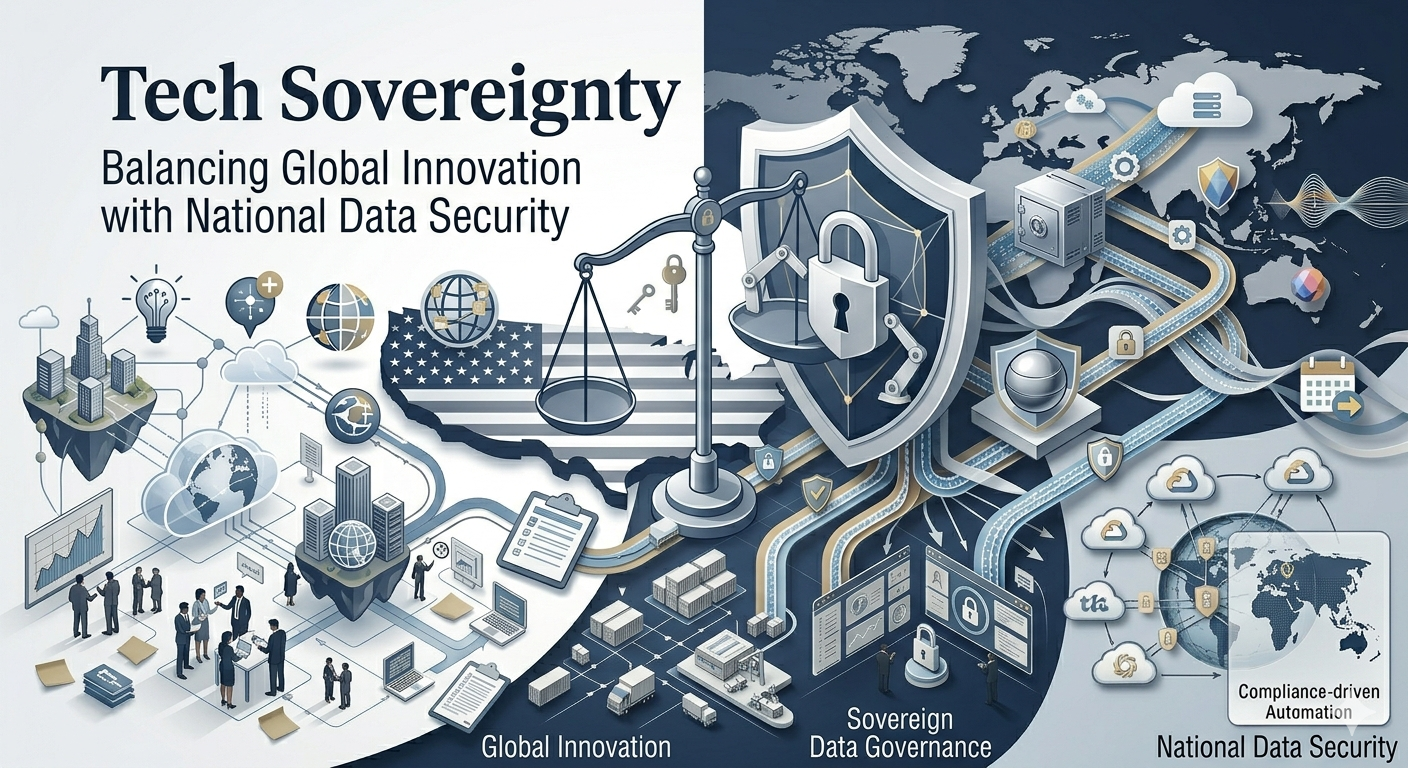

Tech Sovereignty is becoming a major technology strategy as governments and businesses seek greater control over data, artificial intelligence, cloud infrastructure, and critical digital systems. Instead of depending entirely on foreign technology providers, countries are investing in local computing, sovereign cloud environments, semiconductor manufacturing, and domestic AI capabilities. This shift is changing how global companies design their technology infrastructure and manage sensitive information.
Table of Contents
- What Is Tech Sovereignty?
- Sovereign AI Compute
- Data Residency and Data Sovereignty
- Semiconductor Independence
- Tech Sovereignty and Global Enterprise
- The Trust Premium
- The Future of Tech Sovereignty
- Conclusion
What Is Tech Sovereignty?
Tech Sovereignty refers to the ability of a country, organization, or region to maintain meaningful control over critical technology, digital infrastructure, data, and technological capabilities.
For many years, businesses could operate global technology platforms with relatively little concern about where their data was processed or which country’s laws applied to their infrastructure. Increasing regulations, geopolitical tensions, supply-chain risks, and competition over artificial intelligence are changing that model.
Modern Tech Sovereignty is therefore not simply about building technology locally. It also involves controlling where sensitive information is stored, understanding which laws govern that information, and reducing excessive dependence on external technology providers.
Sovereign AI Compute and Tech Sovereignty
Artificial intelligence has become one of the most important areas of digital independence. Countries are investing in high-performance computing infrastructure so they can develop and operate AI systems without relying completely on foreign cloud providers or overseas computing resources.
Tech Sovereignty and Sovereign AI
Sovereign AI infrastructure can include domestic data centers, specialized computing clusters, locally controlled datasets, and national AI models. The objective is to give governments and organizations greater control over how AI systems are developed, trained, deployed, and governed.
This can become especially important when access to advanced computing hardware or AI technologies is affected by international export controls or changing geopolitical relationships.
Tech Sovereignty therefore increasingly includes the ability to maintain reliable access to the computing resources required for strategic AI workloads.
Data Residency and Data Sovereignty
Data residency and data sovereignty are related but different concepts. Data residency generally describes where data is physically stored, while data sovereignty concerns which laws and legal authorities govern that data.
A company could store information inside a particular country while still using infrastructure, ownership structures, or services that create additional legal considerations.
Tech Sovereignty and Sovereign Clouds
Sovereign cloud environments are designed to provide stronger control over data, operations, access, and legal jurisdiction. They can be particularly relevant for sensitive sectors such as healthcare, finance, government, and critical infrastructure.
For businesses operating internationally, Tech Sovereignty can require a more detailed understanding of where data travels, where applications run, who can access infrastructure, and which regulations apply.
Semiconductor Independence and Tech Sovereignty
Semiconductors are another important part of technological independence. Modern economies depend on chips for smartphones, vehicles, servers, industrial equipment, AI systems, and countless other technologies.
The supply-chain disruptions of the early 2020s highlighted the risks created by concentrated semiconductor manufacturing. Governments and businesses have since placed greater attention on expanding domestic and regional chip production.
Tech Sovereignty and Domestic Chip Manufacturing
New semiconductor fabrication plants, research facilities, and chip-design initiatives can help countries reduce dependence on a small number of geographic manufacturing centers.
However, complete independence is difficult because semiconductor production depends on a highly international ecosystem involving equipment manufacturers, raw materials, specialized software, chip designers, and fabrication facilities.
For this reason, Tech Sovereignty often means increasing resilience and strategic control rather than eliminating every international dependency.
Tech Sovereignty and Global Enterprise
For multinational companies, the shift toward Tech Sovereignty can create additional complexity. A single global technology environment may no longer satisfy every country’s regulatory, security, and data requirements.
Businesses may need to adopt a multi-local strategy, where infrastructure and data-management practices are adapted to specific jurisdictions.
Bifurcated Infrastructure and Tech Sovereignty
Some organizations may need different versions of their technology stack for different markets. For example, a European deployment may need to address requirements such as GDPR and the EU AI Act, while infrastructure serving another market may follow a different regulatory framework.
This can increase development, maintenance, compliance, and operational costs. At the same time, it can provide organizations with greater control over sensitive workloads and reduce the risks associated with using a single global infrastructure model.
The Trust Premium in Tech Sovereignty
As organizations become more concerned about data control, technology providers may need to demonstrate stronger transparency and compliance.
Security certifications, governance frameworks, data-handling policies, and documented infrastructure controls can become important when organizations evaluate technology suppliers.
Tech Sovereignty and ISO/IEC 42001
ISO/IEC 42001 is an international standard for artificial intelligence management systems. Organizations can use management-system frameworks such as this to establish structured processes around responsible AI governance.
For companies competing for government or institutional contracts, demonstrating clear governance and control over technology infrastructure can become an increasingly important part of procurement discussions.
In this environment, Tech Sovereignty becomes connected not only to infrastructure but also to trust, governance, compliance, and transparency.
Challenges of Tech Sovereignty
Building greater technological independence is not without challenges. Developing domestic infrastructure can require substantial investment, skilled workers, advanced hardware, and long-term planning.
Businesses can also face higher costs when they maintain separate infrastructure environments for different jurisdictions. Applications may need to be redesigned, data pipelines may need to be separated, and compliance requirements can vary significantly between markets.
Balancing Innovation With Tech Sovereignty
There is also a balance between sovereignty and global innovation. International technology ecosystems provide access to specialized expertise, cloud services, research, hardware, and software.
A completely isolated technology environment could limit access to some of these benefits. As a result, many organizations are looking for strategies that provide greater control over critical systems while continuing to participate in the global technology ecosystem.
The Future of Tech Sovereignty
The future of Tech Sovereignty is likely to involve a combination of local control and international cooperation. Countries may continue developing domestic AI infrastructure, semiconductor capabilities, sovereign cloud environments, and cybersecurity systems while maintaining connections with global technology markets.
For businesses, this could mean designing infrastructure around jurisdictional requirements from the beginning instead of treating data sovereignty as an issue that appears only after expansion into a new market.
Tech Sovereignty and the Next Digital Economy
As AI, cloud computing, semiconductors, and digital services become increasingly important to national economies, control over technology infrastructure will remain a strategic issue.
Companies that understand data location, legal jurisdiction, supply-chain dependencies, and technology governance will be better positioned to navigate an increasingly fragmented digital environment.
Conclusion
Tech Sovereignty is reshaping the relationship between technology, governments, and global businesses. Sovereign AI computing, cloud infrastructure, data controls, and semiconductor investment are becoming important components of national and corporate technology strategies.
For global enterprises, the shift means that technology architecture can no longer be designed around efficiency alone. Data regulations, jurisdiction, supply-chain resilience, security, and local requirements increasingly need to be considered alongside performance and cost.
The emerging model is not necessarily a completely disconnected digital world. Instead, Tech Sovereignty is creating a more localized and carefully governed technology ecosystem where organizations seek greater control over the digital infrastructure that supports their most important operations.