

Table of Content
- Introduction to Edge Computing
- How Edge Computing Is Changing Smart Cities
- Edge Computing and Micro-Edge Infrastructure
- Edge Computing for Physical AI
- Edge Computing With 5G Advanced
- Edge Computing and Autonomous Infrastructure
- Resilience Through Edge Computing
- The Future of Edge Computing
- Conclusion
Introduction to Edge Computing
Edge Computing is transforming the way smart cities collect, process, and respond to information. Instead of sending every piece of data to a distant cloud data center, allows data to be processed closer to where it is created. In modern cities, computing power is increasingly moving into streetlights, intersections, utility poles, vehicles, buildings, and other infrastructure. This shift can help cities respond faster while reducing dependence on centralized systems.
As smart cities become more connected, millions of sensors and intelligent devices continuously generate information. Traffic cameras, environmental sensors, connected vehicles, security systems, and public infrastructure all need fast data processin provides a way to handle much of this information locally, making autonomous infrastructure more responsive and resilient.
How Edge Computing Is Changing Smart Cities
Traditional cloud computing often requires data to travel from a device to a remote data center before a decision can be made. That process can introduce latency, especially when thousands or millions of devices are communicating simultaneously.
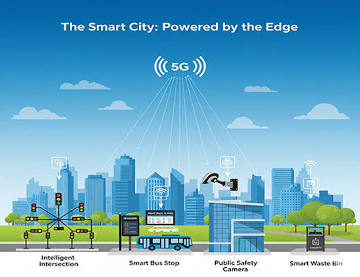
With , processing can happen much closer to the source. A traffic intersection, for example, can analyze camera feeds locally instead of sending every video frame to a distant server. This allows systems to react to changing traffic conditions within milliseconds.
The result is a smart-city infrastructure that can make more decisions locally. Traffic signals can respond to congestion, public lighting can react to movement, and connected infrastructure can identify unusual conditions without waiting for instructions from a centralized cloud platform.
Edge Computing and Micro-Edge Infrastructure
One important development in is the growth of small, ruggedized computing systems designed for deployment directly within urban infrastructure. These systems can be installed near intersections, transportation hubs, utility networks, and other locations where real-time processing is required.
A modern intersection equipped with a micro-edge system can process multiple high-definition camera feeds locally. Instead of continuously transferring large amounts of video data to a central data center, the system can analyze the information at the location where it is generated.
This approach can help traffic management systems identify vehicle movement, pedestrian activity, and congestion more quickly. Intelligent traffic signals can then adjust timing based on current conditions rather than relying only on predefined schedules.
Edge Computing for Real-Time Traffic
Traffic management is one of the clearest applications of Edge Computing in smart cities. Local processing can allow intersections to analyze traffic conditions almost immediately.
For example, if a sudden group of pedestrians approaches a crossing, an intelligent intersection could recognize the change and modify signal timing. Similarly, if an accident causes traffic to build up, nearby systems could respond to the changing flow and provide information to connected vehicles.
By processing information locally, cities can potentially reduce unnecessary data transmission while improving the responsiveness of traffic infrastructure.
Edge Computing for Physical AI
Another major development connected with Edge Computing is Physical AI. Physical AI refers to artificial intelligence systems that interact directly with the physical environment through sensors, machines, vehicles, and infrastructure.
A smart streetlight, for example, can use cameras and sensors to identify different types of movement. Instead of simply detecting that something is moving, an AI-enabled edge device could analyze whether the object appears to be a cyclist, pedestrian, vehicle, or animal.
This local intelligence can allow the infrastructure to react immediately. Lighting levels could change when people approach, while unusual activity could trigger alerts for appropriate city systems.
Edge Computing and Local AI Models
Running AI models locally can provide important advantages. Edge Computing can reduce the amount of sensitive information that needs to be transmitted to remote servers.
Instead of sending an entire video recording to the cloud, an edge device may process the footage locally and send only relevant information, such as an event notification or anonymized data.
This can be particularly useful for smart-city applications where real-time response and responsible data handling are important.
Edge Computing With 5G Advanced
The evolution of Edge Computing is also closely connected with advanced wireless networks. 5G Advanced, sometimes described as 5.5G, is designed to support increasingly demanding connected-device environments.
Smart cities may contain enormous numbers of sensors, vehicles, robots, cameras, and connected devices. These systems need reliable communication to exchange information efficiently.
When high-speed wireless connectivity works together with Edge Computing, devices can communicate with nearby processing systems while reducing the distance data needs to travel. This combination can support applications such as autonomous transportation, connected infrastructure, industrial automation, and real-time public services.
Edge Computing and Autonomous Infrastructure
Autonomous infrastructure represents another important stage in the development of smart cities. Instead of requiring humans to manually control every system, infrastructure can increasingly monitor its surroundings and make predefined or AI-assisted decisions.
Edge Computing can provide the local processing layer needed for these systems. Power networks can monitor equipment, transportation systems can analyze traffic patterns, and environmental sensors can detect changing conditions.
The key concept is distributed intelligence. Rather than relying entirely on one centralized computing system, intelligence can be distributed across thousands of local nodes throughout the city.
Edge Computing for Connected Vehicles
Connected and autonomous vehicles generate enormous amounts of data through cameras, radar, lidar, GPS, and other sensors. Processing some of this information locally can help vehicles and surrounding infrastructure respond quickly.
An intelligent road intersection could communicate with nearby vehicles about traffic conditions, pedestrians, road hazards, or signal changes. Local processing can reduce the time required for certain decisions and help connected transportation systems operate more efficiently.
Resilience Through Edge Computing
One of the most important advantages of Edge Computing is its potential to improve infrastructure resilience. A city that depends entirely on centralized cloud systems can become vulnerable when communication links fail.
Distributed edge systems provide another approach. If a connection to a central data center becomes unavailable, certain local systems can continue operating using their own processing capabilities.
For example, traffic signals could continue following locally stored operating rules, utility systems could continue monitoring equipment, and security systems could continue analyzing sensor data locally.
Edge Computing and Autonomous Survivability
This concept can be described as autonomous survivability. The objective is not to make every part of a city completely independent, but to ensure that critical infrastructure can continue performing essential functions when communication with centralized systems is interrupted.
In this model, the city becomes a network of intelligent nodes rather than a single system dependent on one central location.
That distributed architecture could become increasingly important as cities add more autonomous vehicles, robotic systems, smart utilities, and AI-powered public infrastructure.
The Future of Edge Computing
The future of Edge Computing is likely to involve deeper integration between AI, telecommunications, sensors, robotics, and physical infrastructure. Computing power will continue moving closer to the locations where data is produced and decisions need to be made.
Smart buildings, autonomous vehicles, intelligent roads, energy systems, and public infrastructure could all become part of interconnected edge networks. Instead of simply collecting information, these systems will increasingly analyze information and respond to changing conditions in real time.
However, the expansion of Edge Computing also creates challenges. Cities must consider cybersecurity, privacy, maintenance, interoperability, energy consumption, and the reliability of thousands of distributed computing devices.
Conclusion
Edge Computing is becoming an important foundation for smart cities and autonomous infrastructure because it brings computing closer to the physical world. From intelligent traffic intersections and smart streetlights to connected vehicles and resilient utility systems, local processing can help infrastructure respond faster and operate with greater independence.
As AI and advanced wireless networks continue to develop, Edge Computing could play an increasingly important role in creating cities where digital intelligence is embedded directly into the places people live, travel, and work.