

Carbon-Negative Data Centers are becoming an important part of the technology industry’s response to rising energy demand and environmental pressure. The rapid expansion of artificial intelligence, cloud computing, and digital services has increased the amount of electricity required by modern data centers. As a result, companies are moving beyond traditional energy-efficiency strategies and exploring ways to reduce, offset, and potentially remove more carbon from the atmosphere than their operations produce.
The concept of goes beyond simply purchasing renewable electricity. It can involve renewable energy generation, efficient cooling, heat recovery, carbon removal, circular hardware, intelligent workload management, and improved resource efficiency. Together, these technologies could help create data-center infrastructure with a significantly smaller environmental footprint.
Table of Contents
- Carbon-Negative Data Centers and the AI Energy Challenge
- Carbon-Negative Data Centers Using Circular Cooling
- Carbon-Negative Data Centers and Heat Reuse
- Carbon-Negative Data Centers With Renewable Microgrids
- AI-Optimized Carbon-Negative Data Centers
- Modular Hardware for Carbon-Negative Data Centers
- The Business Value of Carbon-Negative Data Centers
Carbon-Negative Data Centers and the AI Energy Challenge
The rapid growth of generative AI has created new demand for high-performance computing infrastructure. AI workloads can require significant amounts of electricity, particularly when large models are trained or deployed at scale.
This has increased attention on the energy efficiency of. Instead of treating electricity consumption and emissions as separate problems, operators are increasingly looking at the entire infrastructure system, including power generation, cooling, hardware, workload scheduling, and facility design.
Energy Efficiency in Carbon-Negative Data Centers
Improving efficiency is one of the first steps toward reducing emissions. Modern facilities can use advanced cooling systems, efficient power equipment, server optimization, and intelligent energy-management software.
However, energy efficiency alone does not necessarily make a facility carbon-negative. A genuinely carbon-negative strategy requires broader measures that address both operational emissions and carbon removal or equivalent environmental benefits.
Carbon-Negative Data Centers Using Circular Cooling
Cooling is one of the major infrastructure requirements for high-density computing. Traditional cooling systems can consume substantial amounts of energy and water, depending on their design and location.
Modern are exploring alternatives such as liquid cooling, free cooling, advanced airflow management, and other technologies that can reduce the resources required to keep servers operating at appropriate temperatures.
Circular Cooling in Carbon-Negative Data Centers
The idea of circular cooling goes beyond simply removing heat from a server room. Instead, operators can investigate ways to capture and reuse thermal energy produced by computing equipment.
This approach can potentially turn a waste stream into a useful resource while improving overall facility efficiency.
Carbon-Negative Data Centers and Heat Reuse
One of the most interesting developments involvingis the reuse of server-generated heat. Instead of releasing all excess heat into the surrounding environment, some facilities can redirect it toward nearby buildings or industrial processes.
District heating networks are one potential application. Captured heat from computing infrastructure can be transferred through a heat-exchange system and used for heating buildings where local infrastructure allows it.
Heat Recovery for Carbon-Negative Data Centers
The effectiveness of heat reuse depends heavily on geography, temperature requirements, infrastructure, and local demand. A data center located near a suitable heat network may have more opportunities than an isolated facility.
When properly designed, heat recovery can improve the overall energy utilization of and reduce the need for separate heating systems.
Carbon-Negative Data Centers With Renewable Microgrids
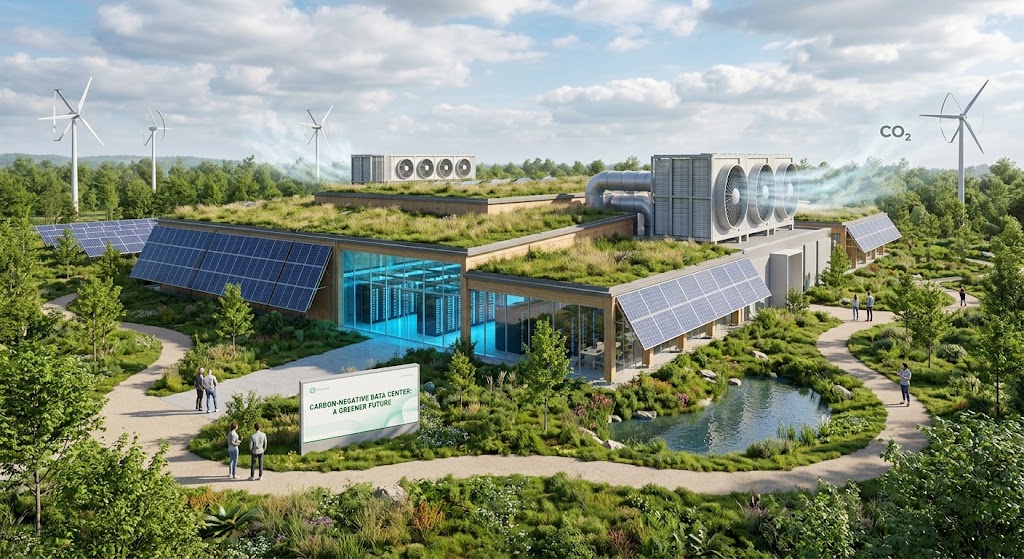
Another major strategy is producing electricity closer to where computing takes place. can use renewable-energy systems such as solar installations, battery storage, and other low-carbon energy sources.
On-site microgrids can provide additional flexibility by combining multiple energy resources and intelligent control systems. Battery energy storage can help balance renewable generation and facility demand.
Renewable Power for Carbon-Negative Data Centers
Solar power is particularly attractive for locations with strong solar resources, while wind power can complement solar generation in suitable regions. Some companies are also investigating nuclear energy and small modular reactor technologies as potential sources of reliable low-carbon electricity.
The exact energy mix varies by location, regulation, cost, and infrastructure. The objective is to reduce dependence on carbon-intensive electricity while maintaining the reliability required by modern computing systems.
AI-Optimized Carbon-Negative Data Centers
Artificial intelligence is not only increasing data-center demand; it can also help manage data-center infrastructure. AI-powered systems can analyze temperature, electricity consumption, server utilization, and workload patterns.
For Carbon-Negative Data Centers, this creates opportunities to dynamically adjust cooling and computing resources according to real-time conditions.
Smart Workload Management in Carbon-Negative Data Centers
Some computing workloads do not need to run at a particular location or exact moment. Operators can potentially move flexible workloads toward facilities where renewable electricity is more available or where environmental conditions reduce cooling requirements.
For example, a workload could potentially be scheduled in a region experiencing high renewable generation. This type of intelligent workload management can help reduce the carbon intensity associated with electricity consumption.
Modular Hardware for Carbon-Negative Data Centers
Hardware sustainability is another important part of Servers contain valuable materials, and replacing entire systems can create unnecessary electronic waste.
Modular server architectures can make it easier to replace individual components rather than discarding complete machines. This can extend hardware lifespans and support more efficient maintenance.
Recycling Hardware in Carbon-Negative Data Centers
Recycling and refurbishment can also reduce the environmental impact associated with manufacturing new components. Designing hardware for easier repair, upgrading, disassembly, and material recovery can support a more circular technology ecosystem.
For Carbon-Negative Data Centers, this approach means sustainability is considered throughout the hardware lifecycle rather than only during facility operation.
The Business Value of Carbon-Negative Data Centers
Sustainability can have practical business implications for operators of Carbon-Negative Data Centers. Electricity represents a major operating expense for large computing facilities, so improving efficiency can potentially reduce long-term costs.
Energy-efficient infrastructure can also help organizations manage exposure to changing energy markets and environmental requirements. In some locations, access to renewable electricity and efficient infrastructure may become an increasingly important factor when selecting sites for new facilities.
Carbon-Negative Data Centers and Regulatory Pressure
Data-center operators also face growing attention from governments, utilities, communities, investors, and customers regarding energy and environmental impacts. Requirements differ significantly by jurisdiction, so companies must evaluate local regulations rather than assuming one global standard.
Organizations that invest in Carbon-Negative Data Centers may therefore be preparing not only for environmental goals but also for changing infrastructure and reporting expectations.
The Future of Carbon-Negative Data Centers
The future of Carbon-Negative Data Centers will likely depend on combining multiple technologies rather than relying on a single solution. Renewable energy, advanced cooling, heat recovery, battery storage, AI-based optimization, efficient hardware, and carbon-removal strategies can work together as part of a broader infrastructure model.
The growth of AI makes this transition particularly important because computing demand is continuing to expand. Data-center operators will need to balance performance, reliability, cost, and environmental impact.
Smarter Carbon-Negative Data Centers for the Future
Future facilities may become more closely integrated with local energy systems. A data center could potentially operate as both a major electricity consumer and an active participant in the energy ecosystem by using flexible workloads, storing energy, recovering heat, and coordinating renewable generation.
This could make Carbon-Negative Data Centers an important part of the next generation of sustainable digital infrastructure.
Conclusion
Carbon-Negative Data Centers represent a broader vision for sustainable computing in which energy efficiency, renewable power, heat recovery, intelligent workload management, and circular hardware work together.
As AI and cloud services continue to expand, reducing the environmental impact of computing will become increasingly important. The transition toward Carbon-Negative Data Centers is not simply about using greener electricity; it involves redesigning how data centers generate, consume, reuse, and manage resources.
The technology is still developing, and achieving genuinely carbon-negative operations can be technically and economically challenging. Nevertheless, the combination of clean energy, smarter infrastructure, efficient cooling, reusable heat, and circular hardware provides a pathway toward a more sustainable digital future.