


Crypto Security in 2026 is becoming a major focus as blockchain networks prepare for emerging threats from increasingly powerful computing systems. Cryptocurrency security is no longer only about protecting passwords, private keys, and exchange accounts. Researchers and developers are also examining whether existing cryptographic systems can remain secure if large-scale quantum computers become practical.
Most blockchain networks rely on public-key cryptography to authorize transactions. This technology has provided strong protection for digital assets, but future quantum computers could create new challenges for some widely used cryptographic algorithms. As a result, is increasingly connected to post-quantum cryptography, quantum-resistant signatures, wallet upgrades, and new blockchain security architectures.
Table of Contents
- Crypto Security in 2026 and the Quantum Threat
- Crypto Security in 2026 and Post-Quantum Cryptography
- Lattice-Based Signatures for Crypto Security in 2026
- Hybrid Wallets and Crypto Security in 2026
- ZK-Rollups and Crypto Security in 2026
- Algorithm Agility in Crypto Security in 2026
- MPC Technology and Crypto Security in 2026
- Institutional Custody and Crypto Security in 2026
- The Future of Crypto Security in 2026
Crypto Security in 2026 and the Quantum Threat
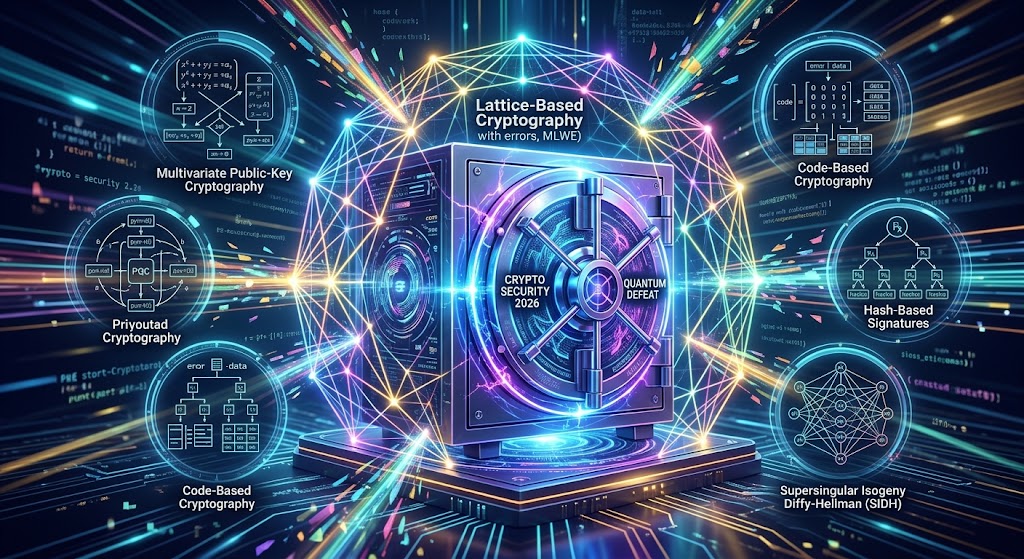
One of the biggest emerging discussions surrounding is the potential impact of quantum computing. Current blockchain systems commonly use cryptographic techniques based on mathematical problems that are difficult for conventional computers to solve.
A sufficiently powerful fault-tolerant quantum computer could theoretically use Shor’s algorithm to attack certain public-key cryptographic systems. This does not mean that existing cryptocurrencies are currently being broken by quantum computers. Rather, it highlights why developers are researching alternatives before such machines become capable of posing a practical threat.
Public Keys and Crypto Security in 2026
Public-key exposure is an important consideration in blockchain security. Depending on the blockchain and address design, transaction activity can reveal cryptographic information that could become relevant to future attacks.
For the focus is therefore shifting toward preparing systems before a hypothetical “Q-Day,” the point at which quantum computing could become powerful enough to threaten widely deployed cryptographic protections.
Crypto Security in 2026 and Post-Quantum Cryptography
Post-quantum cryptography, commonly called PQC, is designed to provide cryptographic security against both conventional and quantum-capable attackers. It is becoming an important research area for blockchain developers and security engineers.
The goal is not simply to create stronger versions of existing algorithms. Instead, researchers are developing cryptographic approaches based on mathematical problems that are believed to remain difficult for quantum computers.
Quantum-Resistant Ledgers and Crypto Security in 2026
Some blockchain projects are exploring quantum-resistant ledger designs in which transaction signatures use post-quantum algorithms from the beginning.
Other networks may eventually introduce upgrade mechanisms that allow existing cryptographic systems to transition toward quantum-resistant alternatives. This flexibility could become an important part of as cryptographic standards continue to evolve.
Lattice-Based Signatures for Crypto Security in 2026
Lattice-based cryptography is one of the major families being investigated for post-quantum security. Its security relies on mathematical problems involving high-dimensional lattices that are believed to be difficult for both classical and quantum computers.
For lattice-based signatures are particularly interesting because digital signatures are fundamental to blockchain transactions. A secure signature system allows a network to verify that a transaction was authorized by the legitimate owner of an asset.
Why Lattice-Based Cryptography Matters for Crypto Security in 2026
Moving blockchain networks toward new signature systems can be technically complicated. Developers must consider transaction size, verification speed, storage requirements, compatibility, and implementation security.
This means the transition to post-quantum cryptography is likely to require careful testing rather than a simple replacement of one algorithm with another.
Hybrid Wallets and Crypto Security in 2026
Another potential approach to is the use of hybrid cryptographic systems. A hybrid wallet could combine a conventional signature with a post-quantum signature, allowing users to maintain compatibility while adding another layer of protection.
This approach can be useful during a transition period because blockchain ecosystems cannot necessarily replace every existing cryptographic component at once.
Dual-Signing for Crypto Security in 2026
A dual-signing model may require two independent signatures before a transaction is accepted. One could use an established cryptographic system while another uses a post-quantum algorithm.
The exact implementation depends on the blockchain protocol and wallet architecture. Nevertheless, hybrid approaches illustrate how Crypto Security in 2026 could evolve from traditional key protection toward cryptographic agility.
ZK-Rollups and Crypto Security in 2026
Zero-knowledge technology has become an important part of blockchain scalability and privacy research. ZK systems allow certain claims to be verified without revealing all underlying information.
In , researchers are also considering the cryptographic assumptions behind zero-knowledge systems. Some proof systems, including STARK-based approaches, are designed around hash-based assumptions that differ from the assumptions used by traditional elliptic-curve cryptography.
Quantum-Resistant Proof Systems and Crypto Security in 2026
Post-quantum security is not automatically guaranteed simply because a blockchain uses zero-knowledge technology. Each cryptographic component must be evaluated according to its own security assumptions.
For this reason, involves examining signatures, hashing systems, proof systems, key management, and network protocols as separate parts of the overall security architecture.
Algorithm Agility in Crypto Security in 2026
Algorithm agility means designing systems so cryptographic algorithms can be replaced or upgraded when necessary. This concept could become increasingly important .
A blockchain that can upgrade its signature mechanisms without requiring disruptive migrations may have more flexibility when new security standards become available.
Upgradable Wallets and Crypto Security in 2026
Wallet developers can also consider mechanisms that allow users to transition between supported cryptographic schemes. Instead of treating an address or signature algorithm as permanently fixed, future-oriented systems may provide controlled upgrade paths.
This type of flexibility could help the cryptocurrency ecosystem respond to new cryptographic research and emerging security requirements.
MPC Technology and Crypto Security in 2026
Multi-Party Computation, or MPC, is another technology relevant to . MPC allows multiple parties or devices to participate in sensitive computations without necessarily reconstructing a complete private key in one location.
MPC can improve key-management architecture by reducing reliance on a single device or storage location. It is already being explored for institutional and enterprise digital-asset custody.
MPC Wallets and Crypto Security in 2026
MPC does not automatically make a cryptocurrency wallet quantum-resistant. Its primary value is in key management and reducing certain single-point-of-failure risks.
Therefore, Crypto Security in 2026 may increasingly combine advanced key-management systems such as MPC with cryptographic algorithms designed to address future quantum threats.
Institutional Custody and Crypto Security in 2026
As digital assets become more integrated into financial infrastructure, institutional custody is another important part of Crypto Security in 2026.
Professional custody systems can use multiple layers of security, including access controls, hardware security, transaction policies, key-management procedures, monitoring, and multi-party authorization.
Quantum-Ready Custody and Crypto Security in 2026
Custody providers and financial institutions are also examining how their systems could respond to post-quantum cryptographic requirements.
Rather than relying on a single security technology, future custody infrastructure may combine algorithm agility, hardware protection, MPC, policy controls, and post-quantum cryptography.
The Future of Crypto Security in 2026
The future of Crypto Security in 2026 is likely to be shaped by preparation rather than panic. Quantum computers capable of breaking widely used public-key systems at scale are not currently available, but the possibility is significant enough for researchers and developers to investigate migration strategies today.
Blockchain networks may gradually adopt post-quantum signatures, hybrid wallets, flexible cryptographic architectures, improved key management, and upgraded custody systems.
The most important development may be the creation of blockchain infrastructure that can adapt as cryptographic standards change. Instead of waiting for a major security crisis, developers can build systems capable of upgrading their defenses over time.
Conclusion
Crypto Security in 2026 is expanding beyond traditional wallet protection toward a broader approach that includes post-quantum cryptography, quantum-resistant signatures, hybrid wallets, zero-knowledge systems, algorithm agility, MPC, and institutional custody.
The quantum threat remains a future-looking security concern rather than a current capability of ordinary attackers. However, preparing blockchain infrastructure in advance could help the ecosystem respond more effectively if quantum computing eventually reaches the required scale.
As cryptocurrency technology continues to evolve, Crypto Security in 2026 will increasingly depend on flexible architectures that can adapt to new cryptographic threats without sacrificing usability, compatibility, or network reliability.