
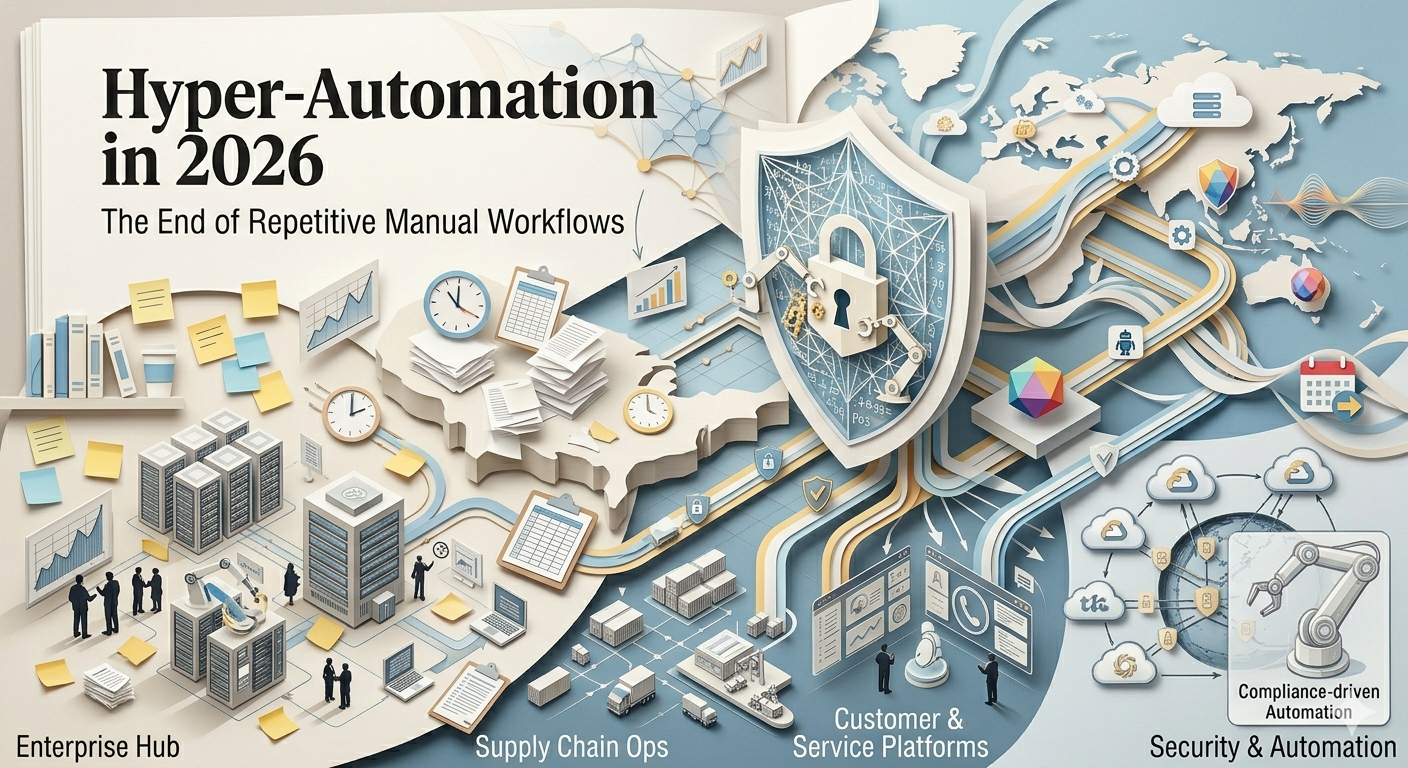

Hyper-Automation in 2026 is changing how businesses handle repetitive work by combining artificial intelligence, robotic process automation, machine learning, workflow orchestration, and intelligent decision-making. Instead of simply automating one task at a time, modern organizations can connect multiple technologies to create workflows that operate with minimal human intervention. From processing invoices to updating business systems, is helping companies move toward faster, smarter, and more efficient operations.
Table of Contents
- What Is Hyper-Automation in 2026?
- Why Hyper-Automation in 2026 Matters
- AI-Powered Workflow Automation
- The Zero-Touch Office
- Citizen Developers and Automation Champions
- Benefits of Hyper-Automation in 2026
- Challenges of Hyper-Automation in 2026
- How Businesses Can Prepare
- The Future of Hyper-Automation in 2026
- Conclusion
What Is Hyper-Automation in 2026?
Hyper-Automation in 2026 goes beyond traditional automation. Conventional automation typically follows predefined rules, while hyper-automation combines multiple technologies to identify, execute, monitor, and improve business processes.
Artificial intelligence can interpret information, automation platforms can execute tasks, and workflow systems can connect different applications. Together, these technologies can create more adaptive processes that require fewer manual steps.
The major difference is the level of coordination. is not about automating a single repetitive action. It is about creating an interconnected system where several automated processes work together.
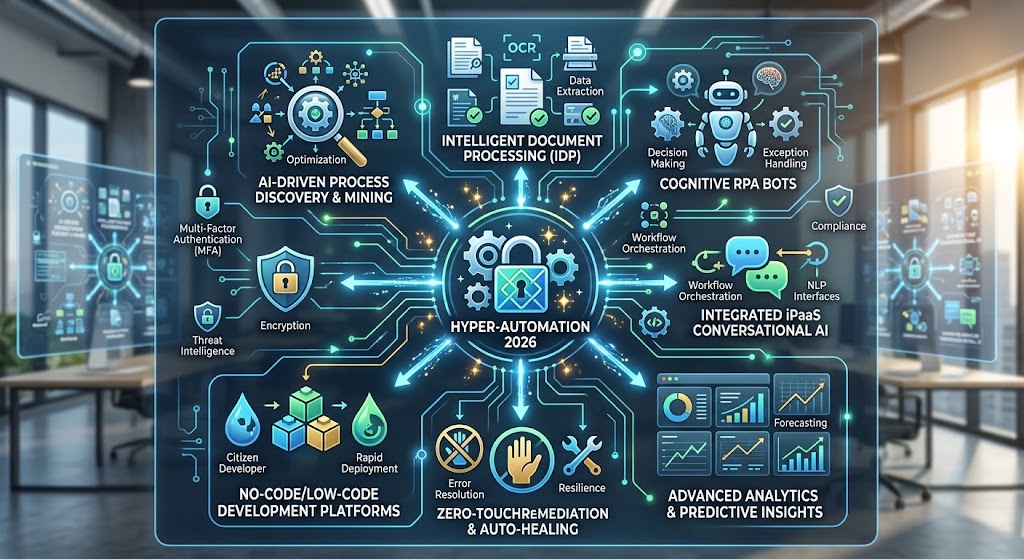
How Hyper-Automation in 2026 Works
A modern hyper-automated workflow may begin when an event occurs, such as receiving an email or uploading a document. AI can analyze the information, determine what action is required, and trigger the appropriate workflow.
The system can then communicate with databases, enterprise software, payment platforms, or customer-service systems. Human employees can remain involved when an unusual situation requires judgment or approval.
This model allows Hyper-Automation in 2026 to focus human attention on exceptions instead of routine processing.
Why Hyper-Automation in 2026 Matters
Businesses generate enormous amounts of digital information every day. Employees often spend valuable time copying data, checking documents, updating records, sending notifications, and moving information between different systems.can connect these repetitive activities into automated workflows. This can reduce unnecessary manual effort while allowing employees to spend more time on analysis, creativity, customer relationships, and strategic work.
The technology is particularly relevant for organizations operating across multiple departments and software platforms because connected automation can reduce the friction between systems.
AI-Powered Workflow Automation
Artificial intelligence is one of the most important components of. AI systems can interpret unstructured information such as emails, documents, invoices, forms, and customer requests.
Traditional automation might require information to be entered into a specific format. AI-powered automation can potentially understand information that varies in structure and then determine the next step.
Hyper-Automation in 2026 and Intelligent Decisions
AI can add decision-making capabilities to automated workflows. For example, a system may examine an invoice, compare it with a purchase order, check relevant information, and determine whether it falls within predefined rules.
If everything appears normal, the workflow can continue automatically. If the system detects an unusual difference, it can send the case to a human employee.
This combination of automation and intelligent analysis makes Hyper-Automation in 2026 more flexible than basic rule-based automation.
The Zero-Touch Office
One emerging vision associated with Hyper-Automation in 2026 is the “zero-touch” office. The idea is not that humans disappear from business operations, but that routine processes can move forward without requiring employees to manually handle every step.
Consider a finance department receiving invoices through email. An AI system could extract the relevant information, compare it with a purchase order, perform predefined fraud checks, and send the approved information to the payment workflow.
The accounting system could then be updated automatically. A human employee would primarily become involved when the transaction exceeds a predefined confidence threshold or contains an unusual discrepancy.
Hyper-Automation in 2026 and Human Oversight
Human oversight remains important even in highly automated environments. Automated systems can make mistakes, misunderstand unusual information, or encounter situations that were not included in their original rules.
For this reason, Hyper-Automation in 2026 works best when organizations establish clear approval thresholds, monitoring systems, audit trails, and escalation processes.
Citizen Developers and Automation Champions
As repetitive work becomes increasingly automated, employees are also taking a more active role in designing workflows. This is contributing to the growth of the “citizen developer,” a worker who understands business processes and uses low-code or no-code tools to build useful automations.
Hyper-Automation in 2026 and Citizen Developers
A finance employee may understand invoice processing better than a software engineer, while a customer-service employee may understand support workflows better than an IT specialist.
With appropriate governance, Hyper-Automation in 2026 can allow these employees to help create solutions based on their practical knowledge. Instead of simply performing repetitive work, employees can help design systems that automate it.
This creates a shift from doing the process toward designing and improving the process.
Benefits of Hyper-Automation in 2026
The potential benefits of Hyper-Automation in 2026 extend beyond saving time. Connected automation can improve workflow consistency, reduce repetitive data entry, accelerate business processes, and provide better visibility into operations.
When routine tasks are handled automatically, employees can redirect their attention toward activities that require creativity, communication, problem-solving, and human judgment.
Hyper-Automation in 2026 for Faster Operations
Automated workflows can operate continuously and move information between systems without waiting for manual intervention. This can reduce delays in processes such as document processing, customer onboarding, reporting, and internal approvals.
The result can be a more responsive organization where routine work moves forward faster.
Challenges of Hyper-Automation in 2026
Despite its potential, Hyper-Automation in 2026 also introduces challenges. Businesses need to consider security, data quality, system integration, governance, employee training, and reliability before automating critical processes.
Poorly designed automation can simply make a bad process run faster. Organizations should therefore examine and improve workflows before connecting them to automated systems.
Security Risks in Hyper-Automation in 2026
Automated systems may interact with sensitive business information and multiple applications. If access controls are weak, a compromised automation could potentially affect several connected systems.
Strong authentication, least-privilege access, monitoring, logging, and regular security reviews are therefore important components of Hyper-Automation in 2026.
How Businesses Can Prepare for Hyper-Automation in 2026
Businesses do not need to automate everything at once. A practical approach is to identify repetitive processes that consume significant employee time and have clearly defined rules.
Organizations can begin with smaller workflows, measure their results, identify errors, and gradually expand automation to more complex processes.
Successful Hyper-Automation in 2026 also requires employee involvement. Workers who understand the processes should have opportunities to provide feedback and help identify where automation can create genuine value.
The Future of Hyper-Automation in 2026
The future of Hyper-Automation in 2026 is likely to involve deeper connections between AI agents, workflow platforms, enterprise applications, and business data.
Instead of employees manually initiating every step, automated systems may increasingly monitor workflows, identify routine tasks, trigger actions, and escalate unusual cases.
This could create a business environment where automation becomes less visible. Rather than opening a separate automation tool, employees may simply interact with their normal business applications while intelligent systems handle background processes.
Hyper-Automation in 2026 and the End of Repetitive Work
The idea of the “end of manual work” should be understood carefully. Hyper-Automation in 2026 is more likely to reduce certain repetitive activities than eliminate every form of human work.
Human judgment remains valuable for complex decisions, relationships, creativity, leadership, and situations where context matters. The larger shift is that employees may spend less time performing predictable tasks and more time managing, improving, and creating business processes.
Conclusion
Hyper-Automation in 2026 represents a major evolution in business automation. By combining AI, robotic process automation, workflow orchestration, low-code platforms, and intelligent decision-making, organizations can connect repetitive processes into smarter automated systems.
The “zero-touch” office illustrates where this technology can lead: routine tasks can move through multiple systems automatically, while people focus on exceptions and higher-value responsibilities.
For businesses, the opportunity is not simply to automate more tasks. It is to redesign workflows so technology handles predictable work while employees focus on creativity, strategy, and meaningful decisions. With appropriate governance and human oversight, Hyper-Automation in 2026 can become an important foundation for more efficient and adaptable operations.