
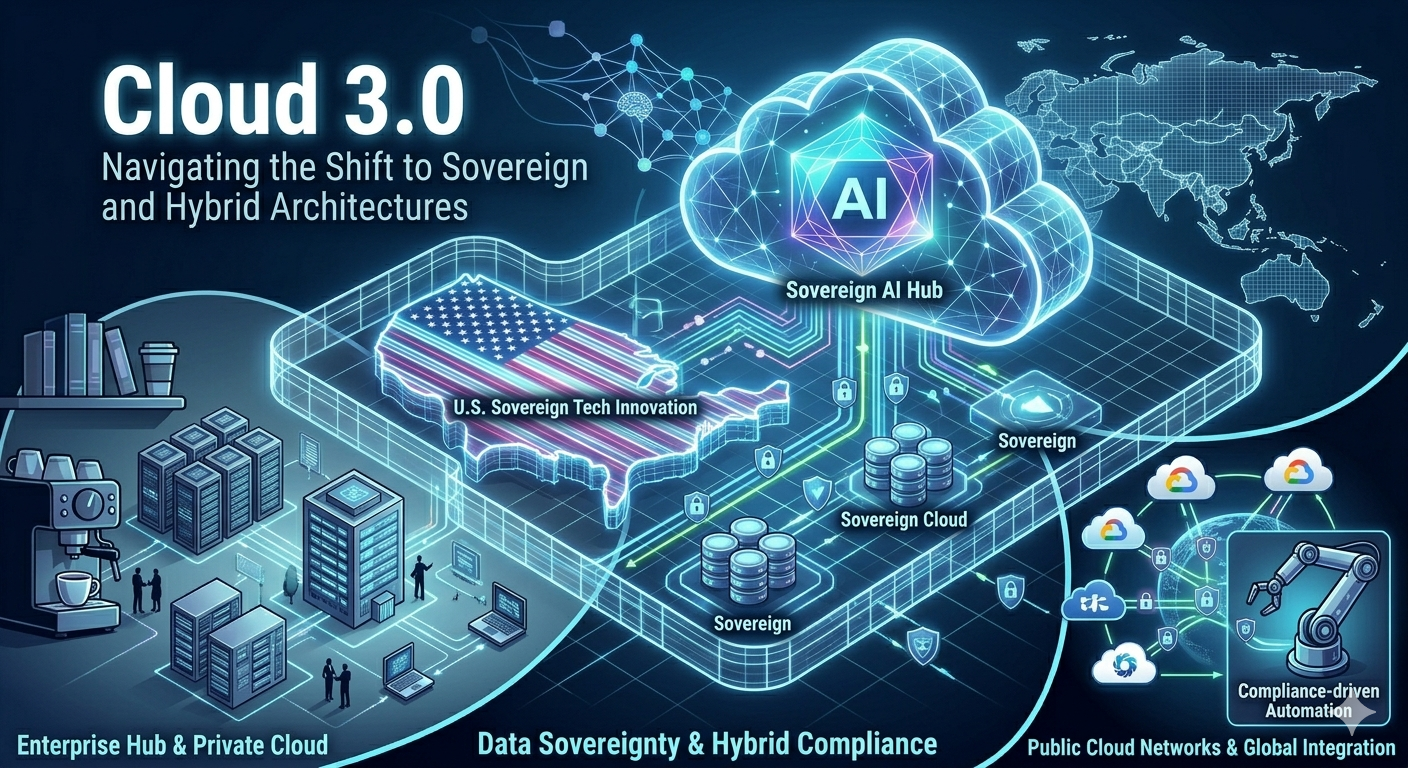

For more than a decade, the cloud industry focused heavily on moving workloads to public cloud platforms. In 2026, that approach is evolving as organizations look for greater control, flexibility, security, and cost efficiency. Cloud 3.0 Hybrid Architecture represents this shift toward combining public cloud, private infrastructure, sovereign environments, and multiple cloud providers according to specific business requirements.
Table of Contents
- What Is Cloud 3.0 Hybrid Architecture?
- Sovereign Cloud Infrastructure
- Hybrid Cloud Infrastructure
- Multi-Cloud Management
- AI and Cloud 3.0 Hybrid Architecture
- Regulatory Pressure
- FinOps and Cost Optimization
- Benefits of Distributed Cloud
- The Future of Cloud 3.0 Hybrid Architecture
What Is Cloud 3.0 Hybrid Architecture?
Cloud 3.0 Hybrid Architecture is an approach to infrastructure that combines different computing environments instead of relying on a single cloud model. An organization might keep sensitive information on private infrastructure while using public cloud services for workloads that require additional scalability.
This model can also include multiple cloud providers and sovereign cloud environments. The exact architecture depends on an organization’s security requirements, regulations, workload characteristics, performance needs, and budget.
Sovereign Cloud Infrastructure in Cloud 3.0 Hybrid Architecture
Sovereign cloud infrastructure is becoming increasingly relevant as governments and organizations pay closer attention to where data is stored and processed. Sovereign environments are designed to provide greater control over data location, access, and applicable legal requirements.
Within Cloud 3.0 Hybrid Architecture, sovereign infrastructure can be combined with other environments. For example, regulated data may remain within a specific jurisdiction while less-sensitive workloads operate through a public cloud.
Hybrid Cloud Infrastructure
Hybrid infrastructure combines private or on-premises computing resources with public cloud services. This allows organizations to decide where different applications and datasets should operate.
Cloud 3.0 Hybrid Architecture can use this approach to keep sensitive workloads under tighter organizational control while taking advantage of public cloud scalability. The result is not necessarily a complete replacement of existing infrastructure but a more flexible combination of environments.
Multi-Cloud Management
Multi-cloud strategies involve using services from more than one cloud provider. Organizations may choose different providers based on technical capabilities, geographic availability, pricing, performance, or specialized services.
Managing several environments can also create additional complexity. Cloud 3.0 Hybrid Architecture therefore requires effective orchestration, monitoring, identity management, security controls, and workload management across infrastructure.
AI and Cloud 3.0 Hybrid Architecture
Artificial intelligence is one of the factors influencing modern infrastructure decisions. AI workloads can require significant computing resources, while proprietary datasets may contain information organizations do not want to move freely between environments.
With Cloud 3.0 Hybrid Architecture, organizations can potentially keep sensitive data or certain AI workloads within controlled private infrastructure while using public cloud resources for other computational requirements.
This approach can provide flexibility, but organizations still need to evaluate performance, security, data-transfer requirements, and infrastructure costs for each workload.
Regulatory Pressure and Cloud 3.0 Hybrid Architecture
Data regulations are another factor behind the move toward more distributed infrastructure. Organizations operating across different countries may need to understand rules concerning data storage, processing, privacy, and access.
Cloud 3.0 Hybrid Architecture can help organizations design infrastructure around these requirements by assigning workloads to environments that meet applicable regulatory and operational needs.
However, technology alone does not guarantee regulatory compliance. Organizations must also maintain appropriate policies, controls, documentation, and governance processes.
FinOps and Cost Optimization
Cloud spending has become an important management issue for organizations operating large-scale infrastructure. FinOps practices help businesses understand and manage cloud costs while balancing performance and operational requirements.
In a Cloud 3.0 Hybrid Architecture, workloads can potentially be distributed according to their cost and performance characteristics. Some workloads may remain in public cloud environments, while others may be better suited to private infrastructure.
The right choice depends on factors such as hardware costs, utilization, data-transfer fees, staffing, licensing, and operational complexity.
Benefits of Cloud 3.0 Hybrid Architecture
One important benefit of Cloud 3.0 Hybrid Architecture is flexibility. Organizations can select different infrastructure environments for different workloads rather than applying one architecture to everything.
Another potential advantage is resilience. Distributing workloads across multiple environments can reduce dependence on a single infrastructure provider, although multi-environment systems also introduce additional management requirements.
Security and data governance can also become more customizable because organizations can determine where specific applications and information should operate.
Challenges of Cloud 3.0 Hybrid Architecture
Despite its advantages, Cloud 3.0 Hybrid Architecture can be complex to implement. Managing multiple environments requires consistent security policies, monitoring, networking, identity management, and operational processes.
Data movement between environments can also create performance and cost considerations. Organizations need to carefully plan how applications communicate and where data is stored.
Another challenge is workforce expertise. Teams may need knowledge across public cloud platforms, private infrastructure, networking, cybersecurity, automation, and cloud governance.
The Future of Cloud 3.0 Hybrid Architecture
The future of Cloud 3.0 Hybrid Architecture is likely to involve increasingly distributed computing environments. Instead of treating the cloud as one centralized destination, organizations can use interconnected infrastructure based on workload requirements.
Automation and orchestration technologies may make it easier to manage workloads across public, private, edge, and sovereign environments. AI-powered infrastructure management may also help teams monitor systems and optimize resource usage.
The central idea is that organizations do not necessarily need to choose one infrastructure model for everything. They can build an environment that combines different technologies according to business, technical, regulatory, and financial requirements.
Conclusion
Cloud 3.0 Hybrid Architecture represents an evolving approach to modern IT infrastructure in which public cloud, private systems, sovereign environments, and multiple providers can work together. The shift is being influenced by AI workloads, data governance, regulatory requirements, resilience, and cloud-cost management.
For organizations planning their next-generation infrastructure, the key consideration is not simply where applications run, but how different environments can be securely and efficiently orchestrated. As cloud infrastructure continues to evolve, hybrid and distributed architectures are likely to remain an important part of enterprise technology strategies.