
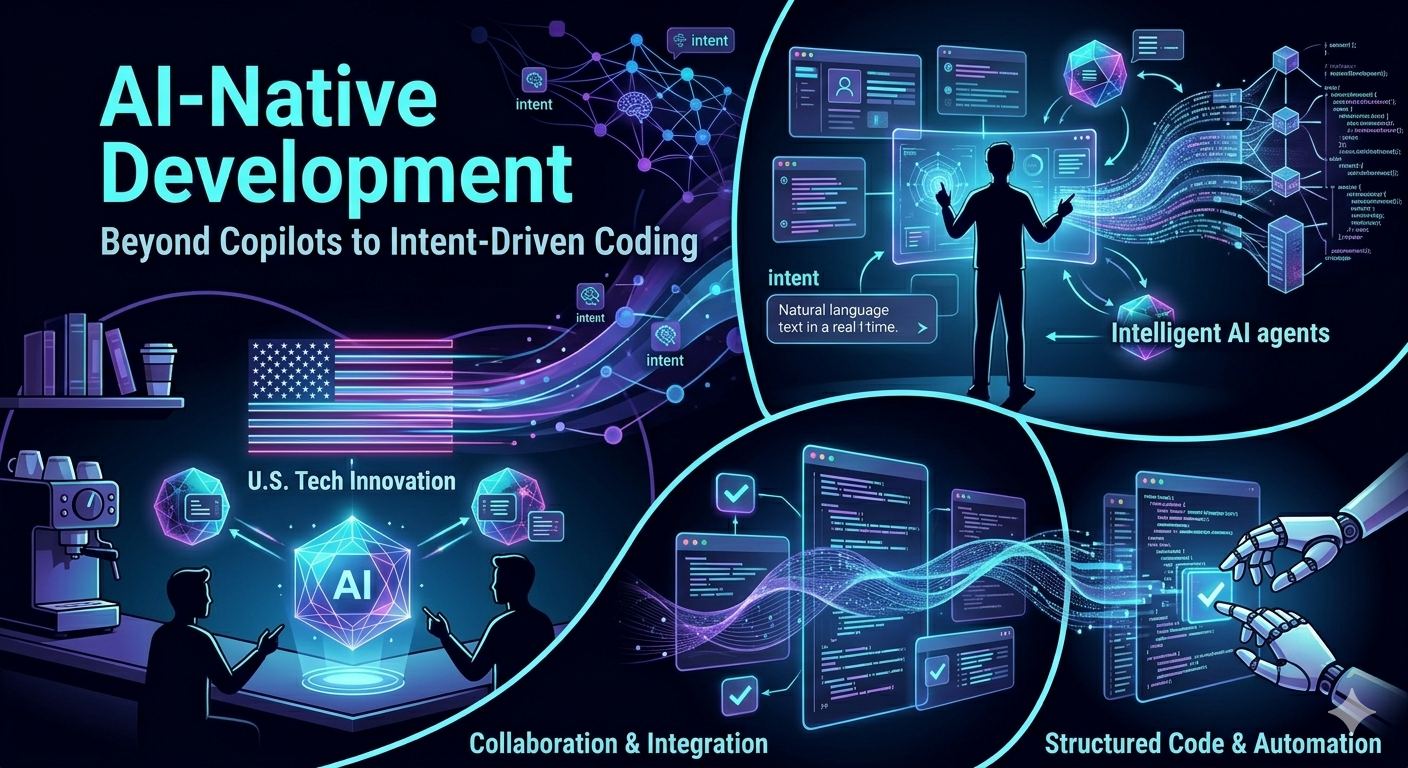

The software development landscape has undergone a major transformation. A few years ago, AI coding copilots were mainly used to suggest code snippets, explain errors, or help developers debug problems. Today, is moving software creation toward a different model in which developers can describe their desired outcomes while AI systems assist with architecture, implementation, testing, and optimization.
The Paradigm Shift in AI-Native Development
Traditional software development requires developers to translate business requirements into programming logic, syntax, testing procedures, and deployment configurations. can reduce some of this translation work by allowing developers to communicate goals and requirements in natural language.
Modern AI-powered development environments can assist with generating code, creating tests, analyzing existing repositories, documenting software, and suggesting improvements. Instead of focusing only on individual lines of code, developers can spend more time thinking about system architecture, requirements, reliability, and user experience.
Why AI-Native Development Matters

One major reason AI-Native Development is gaining attention is development speed. AI tools can automate repetitive programming tasks and help developers move from an initial idea toward a working prototype more quickly. The actual time savings vary depending on the project, tools, complexity, and developer experience.
Another important change is accessibility. People with strong knowledge of a business problem may be able to participate more directly in software creation when AI systems can translate detailed instructions into technical implementations. However, complex production systems still require appropriate technical review and oversight.
AI-Native Development and Intent-Driven Coding
Intent-driven coding focuses on describing what software should accomplish rather than manually specifying every implementation detail. In an workflow, a developer might describe a feature, its expected behavior, constraints, and security requirements. An AI system can then propose implementation approaches and generate supporting code.
This does not eliminate the need for developers to understand the system. Instead, it can change the developer’s role from writing every component manually toward reviewing, directing, testing, and refining AI-generated solutions.
AI-Native Development and Software Architecture
Architecture becomes especially important as AI takes on more implementation tasks. Developers working with AI-Native Development need to understand how databases, APIs, authentication systems, cloud services, microservices, and user interfaces interact.
AI can generate architectural suggestions, but those suggestions need to be evaluated against real-world requirements. Scalability, reliability, maintainability, cost, and security should remain important considerations when designing production software.
AI-Native Development and Automated Testing
Testing is another area where AI-Native Development can provide assistance. AI systems can generate test cases, identify potential edge cases, explain failing tests, and help developers improve test coverage.
However, generated tests are not automatically proof that software is correct. Developers still need to determine whether the tests reflect actual business requirements and whether important failure scenarios have been covered.
AI-Native Development and Self-Healing Systems
The idea of self-healing software is becoming increasingly interesting within AI-Native Development. AI-assisted systems can monitor logs, detect unusual behavior, identify possible performance problems, and recommend corrective actions.
Fully autonomous changes require strong safeguards because automatically modifying production software can introduce new problems. Human approval, automated testing, monitoring, rollback mechanisms, and access controls can help reduce these risks.
The Role of Developers in AI-Native Development
AI-Native Development does not simply remove developers from the software-development process. Instead, it can shift attention from repetitive implementation toward system design, requirements, validation, and technical decision-making.
Developers increasingly need to understand how to communicate requirements precisely, evaluate AI-generated code, identify security problems, and determine whether an implementation actually solves the intended problem.
System Design in AI-Native Development
System design remains an important skill in AI-Native Development. Developers need to understand how different components communicate and how data moves through a system.
An AI model may generate technically valid code that does not fit the larger architecture. Human review is therefore important when making decisions about databases, APIs, authentication, infrastructure, and service boundaries.
Security in AI-Native Development
Security oversight is another critical part of AI-Native Development. AI-generated code can contain vulnerabilities, insecure configurations, excessive permissions, or inappropriate handling of sensitive information.
Developers should review authentication, authorization, input validation, dependency management, data protection, and other security requirements before deploying AI-assisted code.
Prompt Engineering in AI-Native Development
Clear instructions can significantly affect the usefulness of AI coding systems. In AI-Native Development, developers can provide context about requirements, constraints, architecture, expected behavior, and testing criteria.
The goal is not simply to write a longer prompt. Effective instructions provide the AI with enough relevant context to understand what the software should accomplish and what limitations it must follow.
Challenges of AI-Native Development
Despite its potential, AI-Native Development introduces several challenges. AI-generated code can contain errors, misunderstand requirements, rely on outdated approaches, or create security issues.
Another challenge is verification. As AI produces larger portions of an application, developers may need stronger review and testing processes to ensure that the resulting system behaves as expected.
There is also the question of maintainability. Teams need to understand AI-generated components well enough to debug, update, and maintain them over time.
The Future of AI-Native Development
The future of AI-Native Development is likely to involve increasingly capable development environments that can work across multiple stages of the software lifecycle. AI may assist with requirements analysis, architecture proposals, implementation, testing, documentation, monitoring, and maintenance.
The developer’s role may increasingly resemble that of an orchestrator who defines objectives, evaluates alternatives, manages constraints, and verifies results. Human judgment will remain important because software ultimately has to satisfy real users, businesses, security requirements, and technical constraints.
Conclusion
AI-Native Development represents a shift from manually producing every part of a software system toward expressing intent and using AI to assist with implementation and maintenance. Coding copilots remain useful, but the broader concept goes beyond autocomplete and individual code suggestions.
The emerging development model places greater emphasis on architecture, security, testing, requirements, and verification. Developers who understand both software engineering fundamentals and AI-assisted workflows can use these technologies while maintaining control over the systems they build.
The central idea behind AI-Native Development is not that humans stop building software. It is that humans can increasingly focus on defining what software should accomplish while AI helps transform those goals into working technical systems.